

Nanotechnology-based products that address large consumer markets are increasingly being launched. Management at companies making and selling such products must decide how to market those products. In particular, companies must decide whether their marketing campaigns should emphasize the nanoscale components or materials inside of the products. In this article, Patti Hill analyzes the issues associated with a “nano inside” marketing campaign. She provides examples of successful marketing campaigns such as the Intel Inside® Program, highlights the challenges associated with a “nano inside” marketing campaign, and makes recommendations for companies seeking to market nanotech-based products.
A very well considered article from one of today's leading PR minds.
In an earlier post, I told you about my small contribution of background info to Patti Hill's article, at this LINK.
Showing posts with label education. Show all posts
Showing posts with label education. Show all posts
Monday, February 16, 2009


Monday, December 22, 2008
Nano for Kids
Good educational resources for kids at the Nano for Kids site within the CNSE (College of Nanoscale Science and Engineering).
The videos they have done are great entry-level tools: http://cnse.albany.edu/Nano_for_Kids/iKnowNanoTVSegments.html
The videos they have done are great entry-level tools: http://cnse.albany.edu/Nano_for_Kids/iKnowNanoTVSegments.html
Monday, March 12, 2007
Education, Pt. I
Preparing the workforce needed to fill all the jobs to be created by nanotechnologies within the next two decades is a daunting task. Predictions suggest that by 2015, more than 2 million workers will be needed to fill all the jobs created by nanotechnologies. Accordingly, educating the workforce now to fill those high paying future jobs has got to be a priority for any country that desires them.
Along with the other previously posted regular features, education will be a recurring posting.
Here is a synopsis covering the period February 24, 2007, to March 09, 2007.
"Aimed at students between the ages of 15 and 19, the IBN Nano-Bio Kits feature interactive experiments and lessons on practical applications in nanobiotechnology, drug delivery, and medical devices."
(From: Singapore's IBN launches Nano-Bio Kits to teach nanotechnology
http://www.smalltimes.com/articles/article_display.cfm?Section=ONART&C=Educa&ARTICLE_ID=286791&p=109)
"According to him, the interest among students for 'pure science' in both India and the U.S. are on the decline. ‘Science is a way of thinking. The focus of science education should be to motivate students to learn the subject with interest and instill a scientific temper in them.’"
(From: On a mission http://www.hindu.com/2007/03/02/stories/2007030200920200.htm)
"Researchers at ASU have been studying the impact of nanoparticles, such as titanium dioxide/oxide (TiO2), which is found in sunscreen and many other products, on aquatic organisms. With so much to study in the way of nanoparticles, they agreed to enlist the help of a rather curious high school student."
(From: High school student starts research career early by focusing on nanoparticles found in sunscreen http://www.asu.edu/news/stories/200703/20070302_sunscreen.htm)
"NanoBioNexus has announced its partnership with UCSD Extension, the professional education division of UCSD, with a 40 year history serving as the catalyst for continued economic, intellectual and cultural growth in San Diego and Baja California. NBN has designed a course,"Introduction to Nanobiotechnology" which will be offered April 24th as part of Extension's "Cutting-Edge Knowledge" offerings in the Spring 2007 catalogue. The curriculum and the lead instructor for the course will be provided by NanoBioNexus."
(From: NanoBioNexus Partners with UCSD Extension for Nanobiotechnology Course
http://www.nanotech-now.com/news.cgi?story_id=20897)
"Kashmir University is open for students from all over the world and we are continuing to upgrade the infrastructure to match it with other world class universities."
(From: Kashmir University head for 20 pc reservation to PaK students http://www.kashmirnewz.com/n000132.html)
"Meanwhile, the National Assessment of Educational Progress … 2005 scores in science also showed the most progress among fourth-graders at 68 percent having partial or better understanding (of science). By 12th grade, about half the high schoolers passed the basic level, and 18 percent were even proficient. But that means that half the seniors didn't know enough."
(From: Big arguments build on basic science facts http://www.delawareonline.com/apps/pbcs.dll/article?AID=/20070303/OPINION04/703030309/1105/OPINION)
"Image Dynamics™ have pioneered the development of miniaturised learning & development modules which lasts between 30-120 seconds. This new learning & development process is already gaining significant interest from leading corporations. The process engages the user at a deep emotional level by combining imagery, reflective questions and keywords within a variety of animation sequences."
(From: Powerful Nano-Learning Process Breaks New Ground in Global Learning & Development http://www.nanotech-now.com/news.cgi?story_id=20916)
"To receive a copy of the 2007 Small Times University Survey please email Thomas Markley or call 603-891-9307. For questions regarding the content of the survey - please email Barbara Goode or call 603-891-9194."
(From: Information and FAQ on University Survey 2007 http://www.smalltimes.com/articles/article_display.cfm?Section=ONART&C=Educa&ARTICLE_ID=286166&p=109)
"A well-known Chinese institute that issues global rankings on universities around the world ranked this university (University of Maryland) among the top 25 colleges and universities in three out of five broad academic subject areas this year."
(From: Global rankings give university a boost http://media.www.diamondbackonline.com/media/storage/paper873/news/2007/03/07/News/Global.Rankings.Give.University.A.Boost-2761715.shtml)
"Immerse yourself in the world of the latest research developments - a walk through the Science Tunnel presented by the Max Planck Society makes it possible. The multimedia exhibition will be officially opened on March 7, 2007 in Brussels."
(From: Nanotechnology part of European cutting-edge research exhibition http://www.nanowerk.com/news/newsid=1582.php)
"Assisting immigrants and their children to prepare for opportunities for leadership in their various fields in the United States is the mission of the Paul and Daisy Soros Fellowship program for New Americans."
(From: LCHS Grad Named a Soros Fellow http://www.lacanadaonline.com/articles/2007/03/08/news/lnws-dang301.txt)
"The USC NanoCenter and Benedict College present the South Carolina Citizen’s School of Nanotechnology for this spring beginning March 7 on the Benedict campus."
(From: USC, Benedict Present Nanotechnology School http://www.free-times.com/index.php?cat=1992912064025693&ShowArticle_ID=11000703073039528)
"…told city school district officials earlier this week that the massive reorganization planned for the middle schools and Albany High is missing crucial input from parents and other community members. The plan also calls for transforming Philip Livingston Magnet Academy from a middle school into one of the high school's academies: the academy of nanoscale science, engineering and environmental science."
(From: Caution urged on school makeover http://timesunion.com/AspStories/story.asp?storyID=570389&category=ALBANY&BCCode=&newsdate=3/9/2007)
"Windber Area High School faculty members are looking for ways to get students involved in the field of nanotechnology. School administrators recently attended a tour of the nanotechnology facilities at Pennsylvania State University's main campus in an attempt to find a way to expose students to this new technology."
(From: School explores ways to bring new technology to students http://www.dailyamerican.com/articles/2007/03/09/news/friday/news04.txt)
"'We want to showcase UK Science, raise the profile of science and improve perception of science as a career option.' Though Science is popular, she thinks students should go into the different branches of science and see that it could be interesting and fun."
(From: Young Scientists from UK http://www.sundaytimes.lk/070225/FunDay/fd1.html)
"The Austin Technology Council is launching a new academy focused around science, math and technology to create the next generation of tech experts."
(From: New tech academy launching http://austin.bizjournals.com/austin/stories/2007/02/26/daily21.html)
"The goal is to develop opportunities for SDSU faculty and students working in partnership with Argonne to pursue fields of science and technology that are of mutual interest and that, importantly, advance science and technology-driven economic development in South Dakota."
(From: SDSU forms partnership with Argonne National Laboratory http://media.www.sdsucollegian.com/media/storage/paper484/news/2007/02/28/News/Sdsu-Forms.Partnership.With.Argonne.National.Laboratory-2749173.shtml)
For custom reports in your areas of interest, contact me at rocky at bir-consulting.com
Wednesday, March 7, 2007
How is nanotechnology perceived?
Several articles on how nanotechnology is perceived by the public crossed my desk this morning, so I thought I would pass along a few pertinent excerpts.
"According to a recent Eurobarometer, Europeans do not perceive nanotech as risky; rather, they support its development, perceive it as being useful to society and morally acceptable and have far greater confidence in regulation than for example their transatlantic counterparts in the US or Canada.
Everybody agrees that more research on the health and environmental risks posed by nanoparticles is needed to be sure that asbestos-type disasters will not come back to haunt nanotech companies in the future.
Consumer confidence and public trust in nanotech are also directly linked with access to understandable information on the technology. Such information will allow people to understand what nanotechnology is, how it will be applied and its implications for society. Involving citizens with science policymaking through an open debate and analysis of benefits and risks (both real and perceived) of nanotech have been highlighted as one way forward in regulating nanotech."
(From Nanotechnology and consumer confidence http://www.euractiv.com/en/science/nanotechnology-consumer-confidence/article-161268
"The U.S. public's perception of nanotechnology is up for grabs," said Yale University Professor Dan Kahan, one of the online survey's investigators. "It could divide along the lines of nuclear power, global warming and other contentious environmental issues, absent a major public education and engagement effort by industry, government, civic groups and scientists."
(From Survey finds nanotechnology attitudes vary http://www.sciencedaily.com/upi/index.php?feed=Science&article=UPI-1-20070307-10034000-bc-us-nanotechnology.xml
"As the emerging field of nanotechnology enters the public consciousness, mass media play an important role in shaping public attitudes about the new science. …newspapers and the Internet help people better understand nanotechnology research, but television news accounts have a more emotional effect."
(From Media effects on public attitudes toward nanotechnology
http://www.news.wisc.edu/13534.html)
"…when it comes to nanotechnology, Lakhtakia and his colleagues found most people aren't paying much attention. Or, if they are aware of the field, their reactions are too often overly enthusiastic, uninformed or alarmist."
(From Most people nanotechnology ignorant
http://www.sciencedaily.com/upi/index.php?feed=Science&article=UPI-1-20070122-15323700-bc-us-nanotechnology.xml)
"Control and tighter regulations are required to make nanotechnology safer, proclaimed the U.N. on 5th February 2007. UNEP (U.N.'s Environment Program) in its yearly report on global environment said, swift action from the policy makers was the need of the hour so as to allow the proper evaluation of new science."
(From Nanotechnology Needs Tighter Control
http://www.newswiretoday.com/news/14937/)
And listen to the debate points as they are being considered by our cousins down under at:
The Implications for Health, Safety and the Environment of the Nanotech Revolution
Total running time 33 mins, File size: 13.4Mb, File Type: mp3 (www.azonano.com/podcasts/nano.mp3)
I also recommend the magazine Nanotechnology Perceptions - A Review of Ultraprecision Engineering and Nanotechnology. See http://pages.unibas.ch/colbas/ntp/ for details.
"According to a recent Eurobarometer, Europeans do not perceive nanotech as risky; rather, they support its development, perceive it as being useful to society and morally acceptable and have far greater confidence in regulation than for example their transatlantic counterparts in the US or Canada.
Everybody agrees that more research on the health and environmental risks posed by nanoparticles is needed to be sure that asbestos-type disasters will not come back to haunt nanotech companies in the future.
Consumer confidence and public trust in nanotech are also directly linked with access to understandable information on the technology. Such information will allow people to understand what nanotechnology is, how it will be applied and its implications for society. Involving citizens with science policymaking through an open debate and analysis of benefits and risks (both real and perceived) of nanotech have been highlighted as one way forward in regulating nanotech."
(From Nanotechnology and consumer confidence http://www.euractiv.com/en/science/nanotechnology-consumer-confidence/article-161268
"The U.S. public's perception of nanotechnology is up for grabs," said Yale University Professor Dan Kahan, one of the online survey's investigators. "It could divide along the lines of nuclear power, global warming and other contentious environmental issues, absent a major public education and engagement effort by industry, government, civic groups and scientists."
(From Survey finds nanotechnology attitudes vary http://www.sciencedaily.com/upi/index.php?feed=Science&article=UPI-1-20070307-10034000-bc-us-nanotechnology.xml
"As the emerging field of nanotechnology enters the public consciousness, mass media play an important role in shaping public attitudes about the new science. …newspapers and the Internet help people better understand nanotechnology research, but television news accounts have a more emotional effect."
(From Media effects on public attitudes toward nanotechnology
http://www.news.wisc.edu/13534.html)
"…when it comes to nanotechnology, Lakhtakia and his colleagues found most people aren't paying much attention. Or, if they are aware of the field, their reactions are too often overly enthusiastic, uninformed or alarmist."
(From Most people nanotechnology ignorant
http://www.sciencedaily.com/upi/index.php?feed=Science&article=UPI-1-20070122-15323700-bc-us-nanotechnology.xml)
"Control and tighter regulations are required to make nanotechnology safer, proclaimed the U.N. on 5th February 2007. UNEP (U.N.'s Environment Program) in its yearly report on global environment said, swift action from the policy makers was the need of the hour so as to allow the proper evaluation of new science."
(From Nanotechnology Needs Tighter Control
http://www.newswiretoday.com/news/14937/)
And listen to the debate points as they are being considered by our cousins down under at:
The Implications for Health, Safety and the Environment of the Nanotech Revolution
Total running time 33 mins, File size: 13.4Mb, File Type: mp3 (www.azonano.com/podcasts/nano.mp3)
I also recommend the magazine Nanotechnology Perceptions - A Review of Ultraprecision Engineering and Nanotechnology. See http://pages.unibas.ch/colbas/ntp/ for details.
Wednesday, February 7, 2007
NanoArt
Today I’d like to point readers to the website of my friend, Cristian Orfescu, and to his NanoArt site.
Cris’ personal website is absolutearts.com. Of particular interest to regular readers and visitors is the section on NanoArt. There you will find examples of art created from science, using technology.
As Cris puts it: “My art is a reflection of the technological movement. I consider NanoArt to be a more appealing and effective way to communicate with the general public and to inform people about the new technologies of the 21st Century. NanoArt is intended to make the public aware of Nanotechnology and how will this impact our lives.”
By day, Cris is a materials scientist and manager of the analytical laboratory at Caleb Technology. This means that he understands nanoscale materials. What he’s trying to do with NanoArt is to help the public understand nanotechnology. He says that he thinks people are unaware of the benefits that nanotechnologies could bring, instead focusing on the perceived dangers. I believe he’s on the right track; many people will probably find that through art, they will be better able to get a handle on advanced science.
As a science writer, I am fascinated by the way Cris uses a scanning electron microscope to create the underlying images, which he then manipulates with PhotoShop to create stunning, three dimensional final products.
As an aspiring artist myself, I find myself drawn into and captivated by his artwork.
His other project is the NanoArt competition. You can view, and are encouraged to vote for, 71 images from 22 artists. While there are many outstanding examples of “science turned art,” my favorite is the one you see as the Picture of the day.
My favorite work by Cris is:
Tribute to Kubrick's Space Odyssey 2001

A nanosculpture created by freezing a tiny drop of colloidal graphite (graphite nanoparticles in a suspension) in Liquid Nitrogen at -196 deg C. The monochromatic scan has been painted digitally. (click to see larger version)
If you then visit his site or buy one of his images, please tell him I sent you.
Cris’ personal website is absolutearts.com. Of particular interest to regular readers and visitors is the section on NanoArt. There you will find examples of art created from science, using technology.
As Cris puts it: “My art is a reflection of the technological movement. I consider NanoArt to be a more appealing and effective way to communicate with the general public and to inform people about the new technologies of the 21st Century. NanoArt is intended to make the public aware of Nanotechnology and how will this impact our lives.”
By day, Cris is a materials scientist and manager of the analytical laboratory at Caleb Technology. This means that he understands nanoscale materials. What he’s trying to do with NanoArt is to help the public understand nanotechnology. He says that he thinks people are unaware of the benefits that nanotechnologies could bring, instead focusing on the perceived dangers. I believe he’s on the right track; many people will probably find that through art, they will be better able to get a handle on advanced science.
As a science writer, I am fascinated by the way Cris uses a scanning electron microscope to create the underlying images, which he then manipulates with PhotoShop to create stunning, three dimensional final products.
As an aspiring artist myself, I find myself drawn into and captivated by his artwork.
His other project is the NanoArt competition. You can view, and are encouraged to vote for, 71 images from 22 artists. While there are many outstanding examples of “science turned art,” my favorite is the one you see as the Picture of the day.
My favorite work by Cris is:
Tribute to Kubrick's Space Odyssey 2001
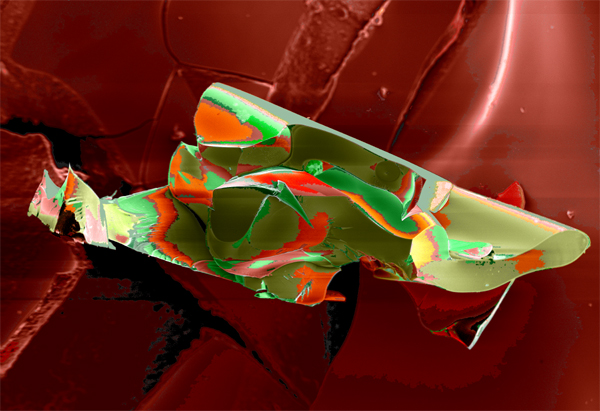
A nanosculpture created by freezing a tiny drop of colloidal graphite (graphite nanoparticles in a suspension) in Liquid Nitrogen at -196 deg C. The monochromatic scan has been painted digitally. (click to see larger version)
If you then visit his site or buy one of his images, please tell him I sent you.
Tuesday, February 6, 2007
Interview with Judith Light Feather
RR: What is your vision regarding the changes that nanotechnology will bring to society?
The long-term vision involves programmable matter and molecular assembly of products whereby humans will move from their 'wage slave' survival mode to a more creative lifestyle that allows them time to learn and create. Everyone should have the same learning opportunities to develop skills and talents to their maximum ability, sharing the results with their neighbors and families. Intellectual property developed from humanity will have the value for exchange now given to mundane products. The properties of nanomaterials which repel dirt and grime, when put into building materials, flooring, glass, appliances and automobiles, will finally free mankind from many of the time consuming chores that take up their precious few leisure hours. Improved clothing and recreation equipment will enhance the lifestyles of society, along with more time to learn new skills and create new ideas for culture benefits.
RR: How can government and educational institutions address the need for significantly larger numbers of nano-educated college grads?
The problems in the universities, regarding the lack of students interested in science reflects back to our main education issues in elementary schools. Until our government leaders realize that the Department of Education was created with no authority to mandate curriculum on a national level, but are permitted to mandate National Testing on the sub-standard curriculum which local schools boards make the decisions to accept, nothing will change.
RR: If you could sit down with the leaders of every country and talk to them about the development of nanotechnology, what issues would you focus on?
We recently had this conversation with the leaders of Thailand and Vietnam concerning development of courses for education and the future technology. The first issue we focused on was types of education modules that would reach all ages and develop into a lifelong learning situation. Education is always first, then the research, then the technology. Culture was an important issue as each country strives to preserve their identity while becoming competitive in a global society. Communication between scientific disciplines and each other was also top on the list. The ability to form relationships and share information in friendship and trust was the result of this first effort.
To read the entire interview, visit:
http://www.nanotech-now.com/Judith-LightFeather-interview.htm
The long-term vision involves programmable matter and molecular assembly of products whereby humans will move from their 'wage slave' survival mode to a more creative lifestyle that allows them time to learn and create. Everyone should have the same learning opportunities to develop skills and talents to their maximum ability, sharing the results with their neighbors and families. Intellectual property developed from humanity will have the value for exchange now given to mundane products. The properties of nanomaterials which repel dirt and grime, when put into building materials, flooring, glass, appliances and automobiles, will finally free mankind from many of the time consuming chores that take up their precious few leisure hours. Improved clothing and recreation equipment will enhance the lifestyles of society, along with more time to learn new skills and create new ideas for culture benefits.
RR: How can government and educational institutions address the need for significantly larger numbers of nano-educated college grads?
The problems in the universities, regarding the lack of students interested in science reflects back to our main education issues in elementary schools. Until our government leaders realize that the Department of Education was created with no authority to mandate curriculum on a national level, but are permitted to mandate National Testing on the sub-standard curriculum which local schools boards make the decisions to accept, nothing will change.
RR: If you could sit down with the leaders of every country and talk to them about the development of nanotechnology, what issues would you focus on?
We recently had this conversation with the leaders of Thailand and Vietnam concerning development of courses for education and the future technology. The first issue we focused on was types of education modules that would reach all ages and develop into a lifelong learning situation. Education is always first, then the research, then the technology. Culture was an important issue as each country strives to preserve their identity while becoming competitive in a global society. Communication between scientific disciplines and each other was also top on the list. The ability to form relationships and share information in friendship and trust was the result of this first effort.
To read the entire interview, visit:
http://www.nanotech-now.com/Judith-LightFeather-interview.htm
Thursday, January 18, 2007
Nanomedicine Education
In an effort to help educate 12 – 18 year olds, the folks at PlayGen have created NanoMission™. NanoMission is a "cutting edge gaming experience which educates players about basic concepts in nanoscience through real world practical applications from microelectronics to drug delivery."
Their press release goes on to say "NanoMission is a learning experience which educates players about basic concepts in nanoscience through real world practical applications from microelectronics to drug delivery. The demo of the first module, nanomedicine, compels the player to select a suitable vehicle to deliver an anti cancer compound, and then navigate through the bloodstream to the site of the tumour, while avoiding the bodies' natural defence mechanisms."
While this tool is aimed primarily at children, adults who are not comfortable with the technologies will find it educational as well.
The following YouTube video takes you inside the bloodstream with a vesicle loaded with anti-cancer molecules.
View the other videos here
Or download the demo here
About PlayGen: Founded in 2001 by gaming industry experts, PlayGen is a London based game development studio with a strong track record in developing serious games for training and learning purposes. See http://www.playgen.com
About Cientifica: Cientifica is the world's leading independent supplier of nanotechnology research and technology information, with activities spanning from consultancy, to business intelligence and investments. See http://www.cientifica.com/
Their press release goes on to say "NanoMission is a learning experience which educates players about basic concepts in nanoscience through real world practical applications from microelectronics to drug delivery. The demo of the first module, nanomedicine, compels the player to select a suitable vehicle to deliver an anti cancer compound, and then navigate through the bloodstream to the site of the tumour, while avoiding the bodies' natural defence mechanisms."
While this tool is aimed primarily at children, adults who are not comfortable with the technologies will find it educational as well.
The following YouTube video takes you inside the bloodstream with a vesicle loaded with anti-cancer molecules.
View the other videos here
Or download the demo here
About PlayGen: Founded in 2001 by gaming industry experts, PlayGen is a London based game development studio with a strong track record in developing serious games for training and learning purposes. See http://www.playgen.com
About Cientifica: Cientifica is the world's leading independent supplier of nanotechnology research and technology information, with activities spanning from consultancy, to business intelligence and investments. See http://www.cientifica.com/
Tuesday, January 16, 2007
The Basics, Pt. II
In keeping with my post titled The Basics, Pt. I I’d like to present an interview I did with my friend Vic Peña, CEO, nanoTITAN, Inc., and Member of the PCAST Nanotechnology Technical Advisory Group (NTAG).
Please talk about some of the social, legal, cultural, ethical, religious, philosophical and political implications of molecular nanotechnology (MNT, a.k.a. molecular manufacturing or MM).
I believe that molecular nanotechnology will profoundly impact the entire socio-economic-technological spectrum of the human experience for the betterment of all humankind. This profound impact will be progressive, with increasing promise to improve the lives of humankind.
As MNT becomes reality, challenges to the framework and values of our present societies worldwide will surface. The legal profession, and political entities, will find that current laws and policies will have to be improved to meet the demands of intellectual property protection, producers' liability, and consumer protection. Most certainly also, National Security.
Concurrent with the development of MNT, political involvement in the establishment of laws and oversight needs to occur. International covenants and treaties will have to be developed to assure the lawful, orderly, and peaceful proliferation of MNT's promise. I would see something akin to the Geneva Convention as a set of guidelines from which to establish an international standard for the use and implementation of MNT worldwide. This said, I would not like a constraining bureaucracy to impede the research and development of the scientific and technological discoveries yet to take place, "for the betterment of all mankind."
There is an educational aspect to this also, as not only will our schools and universities be required to graduate scientists and engineers, but whole new generations of business, law, policy, and social studies graduates will be needed to provide the societal balance required for MNT to have a beneficial effect on humankind.
Finally, ethical, religious, and philosophical beliefs will be tasked, and the tenets upon which these beliefs are built will have to withstand some of the assaults that they will surely experience. Science can be a powerful argument, and our values built upon ethics, religion and philosophy must recognize that a whole new era is upon us.
In your opinion, what should be done - starting right now - to mitigate (if not eliminate) the potential downsides to MNT, as well as to maximize the potential upsides?
I stated earlier, that we (our National Leadership) should be considering a Geneva Convention like structure to focus on the peaceful evolution and development of MNT. Additionally, Educational Institutions as well as Academia should begin preparing for the demands that MNT will bring upon us all. I believe that if people are educated both as a work force, and as consumers, the advantages of MNT will be demanded and the nefarious uses that it can pose will be constrained or at least controlled.
Regarding the nanoscale sciences: Talk a little about education, where we're doing it right, where improvements can be made, and why.
I think that we, the United States of America, are not producing enough talent in the sciences and technologies to maintain our lead in nanotechnology. But beyond the scientists and engineer nanotechnologists, we need to focus on the requirements that nanotechnology will put on our business, legal, policy, and social graduates. One great program recently came to my attention, and that is the "Nano*High" Program at UC Berkley, where every Saturday, lectures and lab tours are offered for free to any interested high school student. This is a great model and should be emulated Nation-wide.
Read the entire interview here
Please talk about some of the social, legal, cultural, ethical, religious, philosophical and political implications of molecular nanotechnology (MNT, a.k.a. molecular manufacturing or MM).
I believe that molecular nanotechnology will profoundly impact the entire socio-economic-technological spectrum of the human experience for the betterment of all humankind. This profound impact will be progressive, with increasing promise to improve the lives of humankind.
As MNT becomes reality, challenges to the framework and values of our present societies worldwide will surface. The legal profession, and political entities, will find that current laws and policies will have to be improved to meet the demands of intellectual property protection, producers' liability, and consumer protection. Most certainly also, National Security.
Concurrent with the development of MNT, political involvement in the establishment of laws and oversight needs to occur. International covenants and treaties will have to be developed to assure the lawful, orderly, and peaceful proliferation of MNT's promise. I would see something akin to the Geneva Convention as a set of guidelines from which to establish an international standard for the use and implementation of MNT worldwide. This said, I would not like a constraining bureaucracy to impede the research and development of the scientific and technological discoveries yet to take place, "for the betterment of all mankind."
There is an educational aspect to this also, as not only will our schools and universities be required to graduate scientists and engineers, but whole new generations of business, law, policy, and social studies graduates will be needed to provide the societal balance required for MNT to have a beneficial effect on humankind.
Finally, ethical, religious, and philosophical beliefs will be tasked, and the tenets upon which these beliefs are built will have to withstand some of the assaults that they will surely experience. Science can be a powerful argument, and our values built upon ethics, religion and philosophy must recognize that a whole new era is upon us.
In your opinion, what should be done - starting right now - to mitigate (if not eliminate) the potential downsides to MNT, as well as to maximize the potential upsides?
I stated earlier, that we (our National Leadership) should be considering a Geneva Convention like structure to focus on the peaceful evolution and development of MNT. Additionally, Educational Institutions as well as Academia should begin preparing for the demands that MNT will bring upon us all. I believe that if people are educated both as a work force, and as consumers, the advantages of MNT will be demanded and the nefarious uses that it can pose will be constrained or at least controlled.
Regarding the nanoscale sciences: Talk a little about education, where we're doing it right, where improvements can be made, and why.
I think that we, the United States of America, are not producing enough talent in the sciences and technologies to maintain our lead in nanotechnology. But beyond the scientists and engineer nanotechnologists, we need to focus on the requirements that nanotechnology will put on our business, legal, policy, and social graduates. One great program recently came to my attention, and that is the "Nano*High" Program at UC Berkley, where every Saturday, lectures and lab tours are offered for free to any interested high school student. This is a great model and should be emulated Nation-wide.
Read the entire interview here
Subscribe to:
Posts (Atom)