Thursday, January 25, 2007

Picture of the day


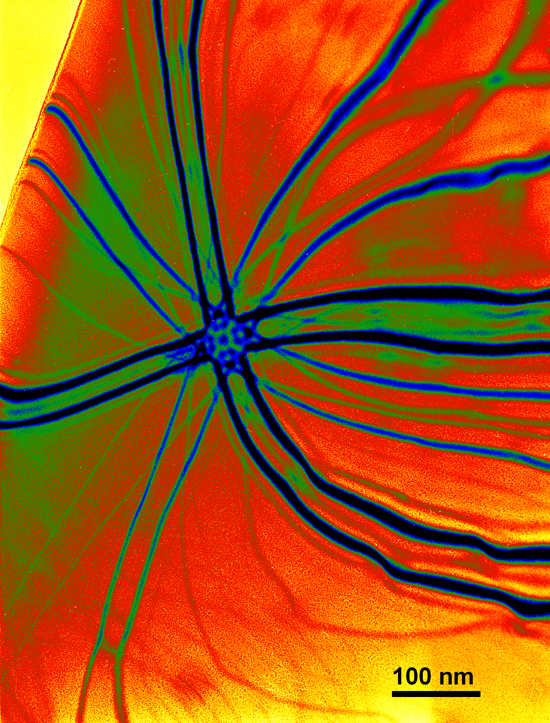
'Dancing' quantum dot


University of Cambridge Department of Materials Science & Metallurgy Gallery, dancing quantum dot


Plan view bright field transmission electron micrograph of a germanium/silicon quantum dot in a silicon matrix. The quantum dot, grown by molecular beam epitaxy, is coherently strained due to Ge/Si crystal lattice mismatches giving rise to strain induced banding contours. The straight edge at the top left shows the Si 110 plane. Field of view is approximately 620nm wide. (click to see full sized version)

Acknowledgments: Diana Zhi, Paul Midgley, Rafal Dunin-Borkowski, Don W. Pashley, Bruce A. Joyce

Visit the University of Cambridge Department of Materials Science & Metallurgy Gallery.

I will post the others in this series over time. To see it all now, visit the Nanotechnology Now Gallery.

Quote of the day

If nanotechnology ... at maturity achieves even a fraction of its promise, it will force the reassessment of global markets and economies and industries on a scale never experienced before in human history. Imagine the emergence of a nanochip that tomorrow would deliver over 50 gigahertz of speed with the processing power of ten supercomputers for the price of a quartz watch and smaller than a key chain. What might the economic impact on the computer industry be overnight? Imagine a super strong and inexpensive material to be used for pipe insulation, construction and manufacturing that would eliminate the market for steel and plastic. How might that influence the economy?

~Dr. James Canton, CEO & Chairman, Institute for Global Futures

Muddying the waters

The History channel is rerunning a 2004 episode titled “Doomsday Tech” in which they profile 4 scenarios, including gray goo.

If you want to learn about nanotechnology and molecular manufacturing, don’t count on this program for instruction; it is both confusing and incomplete.

If, however, you want to learn more about global warming, peak oil, nuclear Armageddon, a new ice age, this looks like a good program to watch.

They point out that the “stunning level of technological progress human beings have achieved in a very short time” has a dark side “we’ve reached a pivotal moment in human history when we as a species possess technologies that could destroy us.”

Yes, gloom and doom; but what did you expect with that title?

Not all of it though: they also discuss alternate energy in the forms of wind power, solar power, tidal (wave) power, hybrid cars, geothermal and hydrogen (fuel cells), so it’s not all a bad trip.

My earlier point about not counting on this program to learn about nanotech starts with scenario #4: Gray Goo. Everybody that has paid attention to this issue knows that gray goo is more of a public perception issue rather than a scientific one. My friends at the Center for Responsible talk about this issue in depth at Grey Goo is a Small Issue (www.crnano.org/BD-Goo.htm). To put it in plain terms, molecular manufacturing doesn’t need self-replicating nanorobots (a.k.a. free-floating autonomous assemblers, as was highlighted in the program).

Much more important and likely molecular manufacturing "bad news" scenarios include (but are not limited to) this list, compiled by CRN:

Economic disruption from an abundance of cheap products
Economic oppression from artificially inflated prices
Personal risk from criminal or terrorist use
Personal or social risk from abusive restrictions
Social disruption from new products/lifestyles
Unstable arms race
Collective environmental damage from unregulated products
Black market in nanotech (increases other risks)
Competing nanotech programs (increases other risks)
Attempted relinquishment (increases other risks)


Back to the program. I also find fault in the way they use “nanotechnology” and “molecular manufacturing” interchangeably, as if the terms meant the same thing. At one time they did, but the day is long since past when old-school scientists and industry co-opted the term “nanotechnology” and rewrote its definition to mean “materials in the .1 nm to 100 nm range, which often exhibit unique properties.” Whereas “molecular manufacturing” means “the building of complex structures by mechanochemical processes.”

Their descriptions (backed by background images of a nanofactory) serve only to further confuse an already confusing subject. At one moment they talk about tiny robots, and at another about super strong materials.

And not once do they talk about the nanofactory, which is featured prominently as background animations.

All in all, a very confusing portrayal of a very important topic; one which left me disappointed with an organization known for its unbiased and accurate programs.

Don’t get me wrong, I did like the information about the first three scenarios. They seem to follow conventional wisdom, and present it in no scarier terms than other portrayals I have seen and read.

One thing I took away from the program, which I watched three times, was a closing quote by Sir Martin Rees:

What we’re seeing in this century is new technologies, which produce greater risk and greater opportunities. We have to insure that we can harness the opportunities and avoid the risks of misuse.

His quote absolutely applies to molecular manufacturing.

To learn more about nanotechnology and molecular manufacturing, visit:

What is Nanotechnology? - http://www.crnano.org/whatis.htm

What are the benefits? - http://www.crnano.org/benefits.htm

What are the dangers? - http://www.crnano.org/dangers.htm


You can buy the video here http://store.aetv.com/html/product/index.jhtml?id=74178 or watch your listings for a repeat of the program.

Wednesday, January 24, 2007

Picture of the day


"Molecular Shuttlecock"


Heinrich Jaeger and Ward Lopes, Nanochain


A molecular shuttlecock, with a buckyball for a head and rod-like structures to form the tail. These shuttlecocks can be stacked like their giant counterparts, but display odd liquid-crystal behaviors.

Image Courtesy of and Copyright © Accelrys.

To learn more, read the press release Batting around molecular shuttlecocks.

Quote of the day

How do today's nanoscale technologies differ from tomorrow's advanced nanotechnology, sometimes called molecular manufacturing? Here is one way to explain it: today's nanotechnologies use big machines to make small products -- by contrast, molecular manufacturing will use small machines to make big products. That sounds simple, but it is really a profound distinction.

From Nanotech Today vs. Nanotech Tomorrow


In molecular nanotechnology (also called molecular manufacturing), assembly is guided by computer controlled nanoscale equipment. That means that the complexity of the output can be increased by feeding in new computer instructions, and a relatively simple manufacturing system can build products that have greater physical complexity.

~Chris Phoenix, Director of Research, the Center for Responsible Nanotechnology

British Breakthrough Highlights Nanotechnology Policy Gap

Breaking my rule again today, for an important press release by my friends at the Center for Responsible Nanotechnolgy. You'll be seeing this in quite a few other places soon, and likely hearing plenty about it later.

NEW YORK, January 24, 2007 - An urgent need for new nanotechnology
policy is highlighted by breakthrough results from a recent British
government funded project. For the first time ever, a group of
high-level scientists assembled for the purpose of inventing something
as close as they could get to the long-sought nanotechnology goal of
building precise products atom by atom. The remarkably advanced
projects those scientists produced -- which they hope to complete in
three to five few years -- suggest that the era of molecular
manufacturing could arrive far more swiftly than previously imagined.

"What this shows, even more strongly than before, is the critical
necessity of additional work on implications and policy," said Mike
Treder, Executive Director of the Center for Responsible
Nanotechnology (CRN). "Existing nanotechnology policies, and most
proposed policies, do not address huge new areas of concern raised by
tomorrow's revolutionary manufacturing potential. That gap could be
calamitous."

Nanofactories will use vast arrays of tiny machines to fasten single
molecules together quickly and precisely, allowing engineers,
designers, and potentially anyone else to make powerful products at
the touch of a button. In a single week of intense interdisciplinary
work, an "IDEAS Factory on the Software Control of Matter" produced
three ground-breaking research proposals that bring the nanofactory
concept closer to reality. The project was sponsored by the UK's
Engineering and Physical Sciences Research Council (EPSRC), a national
science agency that also will fund the proposals.

"If, as expected, nanofactories can be used to build more
nanofactories, then the impacts on society may be extreme," said
Treder. "From remarkable advances in health care, environmental
repair, and poverty reduction, to severe economic disruption,
political upheaval, and the possibility of a new arms race: all these
implications and more must be understood. Now it appears that our time
to prepare is getting shorter."

The goals of the IDEAS Factory project were audacious: to make
progress toward the vision of a "matter compiler" that could build
atomically precise products under computer control. The
forward-looking proposals coming from the IDEAS Factory should expand
expectations as to what's possible at the nanoscale, and hold the
potential to accelerate the development of nanofactory systems.

"This shows that molecular manufacturing, which has been considered a
far-future result of nanotechnology, is now a fruitful topic for
current scientific attention," said CRN Director of Research Chris
Phoenix. "We expect that the IDEAS Factory will be a trend leader,
inducing other nanoscientists to use molecular manufacturing as an
inspiration and target for their work."

Participants in the IDEAS Factory designed research projects using an
innovative process in which scientists from many different fields work
together to bypass the conventional limitations of their fields. The
three proposals they developed are expected to accomplish in just a
few years what might have taken twenty with traditional approaches.
Funding has already been assured by the EPSRC and experimental work
will begin shortly.

ABOUT CRN

The Center for Responsible Nanotechnology (http://CRNano.org) has been
raising awareness about the severe societal and environmental
implications of advanced nanotechnology, and the urgent need for new
policy, since 2002. CRN is an affiliate of World Care, an
international, non-profit, 501(c)(3) organization. The opinions of CRN
do not necessarily represent those of World Care.

MORE INFORMATION

What is the IDEAS Factory? - http://tinyurl.com/ahptw
What is nanotechnology? - http://crnano.org/whatis.htm
What is molecular manufacturing? - http://crnano.org/BD-5MinMM.htm
What is a nanofactory? - http://crnano.org/bootstrap.htm


This is the paragraph that you should keep in mind in the coming weeks, and the one that will generate a lot of chatter:

For the first time ever, a group of high-level scientists assembled for the purpose of inventing something as close as they could get to the long-sought nanotechnology goal of building precise products atom by atom. The remarkably advanced projects those scientists produced -- which they hope to complete in three to five few years -- suggest that the era of molecular manufacturing could arrive far more swiftly than previously imagined.