Tuesday, January 30, 2007

Picture of the day


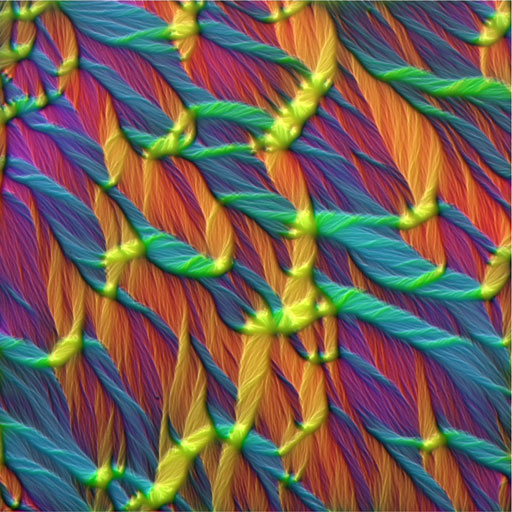
Magnetic Rock


University of Cambridge Department of Materials Science & Metallurgy Gallery, Magnetic Rock

The image shows the magnetic microstructure in a natural, finely exsolved intergrowth of magnetite blocks in an ulvospinel matrix, which is influenced both by the shapes of the individual magnetite blocks and by magnetostatic interactions between them. Different colours correspond to different directions of magnetic induction in the sample. (click to see full sized version)

Acknowledgments: Richard Harrison, Andrew Putnis, Rafal Dunin-Borkowski

Visit the University of Cambridge Department of Materials Science & Metallurgy Gallery.

I will post the others in this series over time. To see it all now, visit the Nanotechnology Now Gallery.

Quote of the day

"What if someone said, 'Here's a new technology that's going to change the world, but it will kill 50,000 people a year.' Would we allow it? But that's exactly what the car has done for us. It's too simplistic to say it's going to be a worse world or a better world. It's going to be a different world."

~Davis Baird, Dean of the South Carolina Honors College.

2057

Last night I watched 2057 – The World. 2057 is a Discovery Channel production, featuring Michio Kaku as "guide."

The theme for the 2057 programs is technologies that will most change the world in the next 50 years. Included among those technologies are those that we talk a lot about on this blog: nanoscale materials, solar energy, nanotubes for space applications, and others.

In The World, the primary theme is the development of super efficient solar cells (being done in a lab 250 miles above the Earth’s surface, tethered like a space elevator), and a growing conflict between the US and China over oil. Not wanting to spoil the plot for you, I’ll stop there, and say that this is a great production, with excellent CGI, descriptive narration, and real world examples of today’s technologies.

I highly recommend that you add this one to your list to watch.

In a future blog note I’ll review the other two programs in the series: The City, and The Body.

To learn more about this program, visit:
http://dsc.discovery.com/convergence/2057/about/about.html

Monday, January 29, 2007

Picture of the day


Magnetic domains in a thin cobalt film


University of Cambridge Department of Materials Science & Metallurgy Gallery, Magnetic domains in a thin cobalt film


The colours in the image show the different directions of the magnetic field in a layer of polycrystalline cobalt that has a thickness of only 20nm. The direction of the magnetic field in the film changes at the positions of domain walls. The field of view is approximately 200µm. The image was acquired using the Fresnel mode of Lorentz microscopy in a field emission gun transmission electron microscope. It was recorded out of focus to enhance the contrast of the domain walls, and then converted to a colour induction map by applying the Transport of Intensity Equation to the image intensity. (click to see full sized version)

Acknowledgments: Anke Husmann, Martha McCartney, Chris Boothroyd, Rafal Dunin-Borkowski

Visit the University of Cambridge Department of Materials Science & Metallurgy Gallery.

I will post the others in this series over time. To see it all now, visit the Nanotechnology Now Gallery.

Quote of the day

"The first nanoscale computer memory device is slated to hit the streets this year. In 2007, the Food and Drug Administration is expected to have approved the first medical device incorporating nanotechnology, and by 2008, nanotechnology enabled solar cells (as thin as wallpaper) will be rolling off presses in California and Japan. As a result, the computer, medical device and energy industries are likely to undergo significant change."

~Jack Uldrich link

Nanotech Videos

Over the weekend, and in the course of doing research for a client, I happened upon YouTube’s nanotechnology video collection.

Let’s start with a summary of the best.

For a bit of history, I recommend the series titled Nanotopia (parts 1 through 6).

Although a bit dated, there is a good nanoscale materials primer by Sandia National Lab, titled Nanotechnology - Thinking Big in a Nano sized World.

There are also a couple futuristic presentations, such as Nanotechnology – Age of Convergence (nanomedicine) and for the military-minded, see Nanotechnology – Super Soldier Suit.

Included in the list is an excerpt from “N” is for Nanotechnology. I reviewed this one in 2005 (see http://www.nanotech-now.com/N-is-for-nanotechnology-review.htm). You can order a copy of the full 30-minute video from my review page.

Nanotech Assembler and Nanofactory Animation are low-rez versions of the nanofactory video, from an excellent production by Lizard Fire Studios in collaboration with Dr. K. Eric Drexler. I recommend visiting http://www.lizardfire.com/html_nano/themovies.html where you can choose from one of three versions.

There are several short productions that cover university work, including Bruker AXS and SUNY CNSE Nanotechnology Customer, Inside CNSE – GetNANO, and Duffield Hall Nanotechnology Center Engineering Quad Cornell (a student with a camcorder).

In the “pluck your heart-strings” category, there is a PSA titled First Lego League: Nanotechnology and HIV/ADIS. This one might also be listed under “futuristic” – the context makes it hard to determine if they are talking about near-term nanomedicine or nanorobotic enabled medicine.

I also found 2 videos promoting a product that makes claims that, in my opinion, are dubious at best. Curiously enough, YouTube has them listed in several categories, including “pyramid scheme” and “scam.” They are The Lifewave Patch Hospital and What is Nanotechnology? Don’t expect to learn about nanotechnology from these two.

When I had completed my research, I counted over 2 dozen videos, and over 2 dozen different and sometimes conflicting definitions of “nanotechnology.” Given this wide variation in definitions, it should come as no surprise that governments and regulatory bodies around the world are having a hard time figuring out how and when to apply regulations to products that incorporate nanoscale materials.

…and there are a bunch of clips from movies, adverts, high school productions, etcetera, most of which can only be classified as having a very loose relationship to nanotechnology. The point being that whereas 5 years ago there were less than a handful of videos available over the internet, today there are dozens.

See them all, here http://youtube.com/results?search_query=nanotechnology