Wednesday, February 7, 2007
Picture of the day
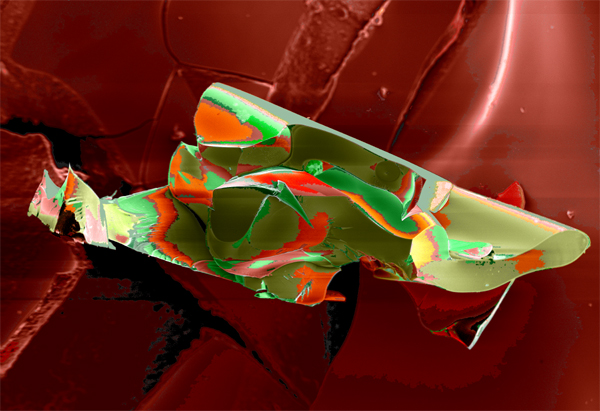
From NanoArt 2006. © Copyright Renata Spiazzi (click to see larger version)
NANOART is a new art discipline related to micro/nanosculptures created by artists/scientists through chemical/physical processes and/or natural micro/nanostructures that are visualized with powerful research tools like Scanning Electron Microscope and Atomic Force Microscope.
NanoArt could be for the 21st Century what Photography was for the 20th Century. We live in a technological society, in a new Renaissance period, and there is no reason for Arts to stay away from Technology. NanoArt is the expression of the New Technological Revolution and reflects the transition from Science to Art using Technology.
See all of Renata Spiazzi's NanoArt 2006 entries here, or visit her website.
Quote of the day
"As an emerging science in its infancy, nanotechnology promises the nano-scale manufacture of materials and machines made to atomic specifications. The impact of nanotechnology on our way of life is widely believed to reach profound and hitherto unimagined levels in the coming decades. Proposed changes include clean abundant energy, pollution-free and inexpensive production of superior defect-free materials, complete environmental restoration and cleanup, safe and affordable space travel and colonization, and quantum leaps in medicine leading to perfect health and immortality. As a result of these advances, we anticipate the obsolescence of nearly all of today's industrial and economic processes by the first half of the new century, leading to global and radical changes in life style, finance, law, and politics."
~Behfar Bastani, Dennis Fernandez link
NanoArt
Today I’d like to point readers to the website of my friend, Cristian Orfescu, and to his NanoArt site.
Cris’ personal website is absolutearts.com. Of particular interest to regular readers and visitors is the section on NanoArt. There you will find examples of art created from science, using technology.
As Cris puts it: “My art is a reflection of the technological movement. I consider NanoArt to be a more appealing and effective way to communicate with the general public and to inform people about the new technologies of the 21st Century. NanoArt is intended to make the public aware of Nanotechnology and how will this impact our lives.”
By day, Cris is a materials scientist and manager of the analytical laboratory at Caleb Technology. This means that he understands nanoscale materials. What he’s trying to do with NanoArt is to help the public understand nanotechnology. He says that he thinks people are unaware of the benefits that nanotechnologies could bring, instead focusing on the perceived dangers. I believe he’s on the right track; many people will probably find that through art, they will be better able to get a handle on advanced science.
As a science writer, I am fascinated by the way Cris uses a scanning electron microscope to create the underlying images, which he then manipulates with PhotoShop to create stunning, three dimensional final products.
As an aspiring artist myself, I find myself drawn into and captivated by his artwork.
His other project is the NanoArt competition. You can view, and are encouraged to vote for, 71 images from 22 artists. While there are many outstanding examples of “science turned art,” my favorite is the one you see as the Picture of the day.
My favorite work by Cris is:
A nanosculpture created by freezing a tiny drop of colloidal graphite (graphite nanoparticles in a suspension) in Liquid Nitrogen at -196 deg C. The monochromatic scan has been painted digitally. (click to see larger version)
If you then visit his site or buy one of his images, please tell him I sent you.
Cris’ personal website is absolutearts.com. Of particular interest to regular readers and visitors is the section on NanoArt. There you will find examples of art created from science, using technology.
As Cris puts it: “My art is a reflection of the technological movement. I consider NanoArt to be a more appealing and effective way to communicate with the general public and to inform people about the new technologies of the 21st Century. NanoArt is intended to make the public aware of Nanotechnology and how will this impact our lives.”
By day, Cris is a materials scientist and manager of the analytical laboratory at Caleb Technology. This means that he understands nanoscale materials. What he’s trying to do with NanoArt is to help the public understand nanotechnology. He says that he thinks people are unaware of the benefits that nanotechnologies could bring, instead focusing on the perceived dangers. I believe he’s on the right track; many people will probably find that through art, they will be better able to get a handle on advanced science.
As a science writer, I am fascinated by the way Cris uses a scanning electron microscope to create the underlying images, which he then manipulates with PhotoShop to create stunning, three dimensional final products.
As an aspiring artist myself, I find myself drawn into and captivated by his artwork.
His other project is the NanoArt competition. You can view, and are encouraged to vote for, 71 images from 22 artists. While there are many outstanding examples of “science turned art,” my favorite is the one you see as the Picture of the day.
My favorite work by Cris is:
A nanosculpture created by freezing a tiny drop of colloidal graphite (graphite nanoparticles in a suspension) in Liquid Nitrogen at -196 deg C. The monochromatic scan has been painted digitally. (click to see larger version)
If you then visit his site or buy one of his images, please tell him I sent you.
Tuesday, February 6, 2007
Picture of the day
The image shows magnetic field lines around the end of an iron wire, which is magnetized along its length. The field of view is approximately 1µm. The image was acquired using electron holography in a field emission gun transmission electron microscope. (click to see full sized version)
Acknowledgments: John Thong, Ken Harada, Akira Tonomura, Tetsuya Akashi and Tsuyoshi Matsuda, Yoshihiko Togawa, Chris Boothroyd, Rafal Dunin-Borkowski.
Visit the University of Cambridge Department of Materials Science & Metallurgy Gallery.
I will post the others in this series over time. To see it all now, visit the Nanotechnology Now Gallery.
Quote of the day
"Over the next ten years, the fields of chemistry, physics, material sciences, biology, and computational sciences will converge in a way that will define nanotechnology and impact almost every industry, including computers, semiconductors, pharmaceuticals, defense, health care, communications, transportation, energy, environmental sciences, entertainment, chemicals, and manufacturing. Previously distinct disciplines will also combine: medicine and engineering, law and science, art and physics, etc. This merging will result in developments that are not simply evolutionary; they will be revolutionary."
~Jack Uldrich & Deb Newberry. From Next Big Thing Is Really Small: How Nanotechnology Will Change the Future of Your Business.
Interview with Judith Light Feather
RR: What is your vision regarding the changes that nanotechnology will bring to society?
The long-term vision involves programmable matter and molecular assembly of products whereby humans will move from their 'wage slave' survival mode to a more creative lifestyle that allows them time to learn and create. Everyone should have the same learning opportunities to develop skills and talents to their maximum ability, sharing the results with their neighbors and families. Intellectual property developed from humanity will have the value for exchange now given to mundane products. The properties of nanomaterials which repel dirt and grime, when put into building materials, flooring, glass, appliances and automobiles, will finally free mankind from many of the time consuming chores that take up their precious few leisure hours. Improved clothing and recreation equipment will enhance the lifestyles of society, along with more time to learn new skills and create new ideas for culture benefits.
RR: How can government and educational institutions address the need for significantly larger numbers of nano-educated college grads?
The problems in the universities, regarding the lack of students interested in science reflects back to our main education issues in elementary schools. Until our government leaders realize that the Department of Education was created with no authority to mandate curriculum on a national level, but are permitted to mandate National Testing on the sub-standard curriculum which local schools boards make the decisions to accept, nothing will change.
RR: If you could sit down with the leaders of every country and talk to them about the development of nanotechnology, what issues would you focus on?
We recently had this conversation with the leaders of Thailand and Vietnam concerning development of courses for education and the future technology. The first issue we focused on was types of education modules that would reach all ages and develop into a lifelong learning situation. Education is always first, then the research, then the technology. Culture was an important issue as each country strives to preserve their identity while becoming competitive in a global society. Communication between scientific disciplines and each other was also top on the list. The ability to form relationships and share information in friendship and trust was the result of this first effort.
To read the entire interview, visit:
http://www.nanotech-now.com/Judith-LightFeather-interview.htm
The long-term vision involves programmable matter and molecular assembly of products whereby humans will move from their 'wage slave' survival mode to a more creative lifestyle that allows them time to learn and create. Everyone should have the same learning opportunities to develop skills and talents to their maximum ability, sharing the results with their neighbors and families. Intellectual property developed from humanity will have the value for exchange now given to mundane products. The properties of nanomaterials which repel dirt and grime, when put into building materials, flooring, glass, appliances and automobiles, will finally free mankind from many of the time consuming chores that take up their precious few leisure hours. Improved clothing and recreation equipment will enhance the lifestyles of society, along with more time to learn new skills and create new ideas for culture benefits.
RR: How can government and educational institutions address the need for significantly larger numbers of nano-educated college grads?
The problems in the universities, regarding the lack of students interested in science reflects back to our main education issues in elementary schools. Until our government leaders realize that the Department of Education was created with no authority to mandate curriculum on a national level, but are permitted to mandate National Testing on the sub-standard curriculum which local schools boards make the decisions to accept, nothing will change.
RR: If you could sit down with the leaders of every country and talk to them about the development of nanotechnology, what issues would you focus on?
We recently had this conversation with the leaders of Thailand and Vietnam concerning development of courses for education and the future technology. The first issue we focused on was types of education modules that would reach all ages and develop into a lifelong learning situation. Education is always first, then the research, then the technology. Culture was an important issue as each country strives to preserve their identity while becoming competitive in a global society. Communication between scientific disciplines and each other was also top on the list. The ability to form relationships and share information in friendship and trust was the result of this first effort.
To read the entire interview, visit:
http://www.nanotech-now.com/Judith-LightFeather-interview.htm
Subscribe to:
Posts (Atom)