Thursday, February 8, 2007

Picture of the day


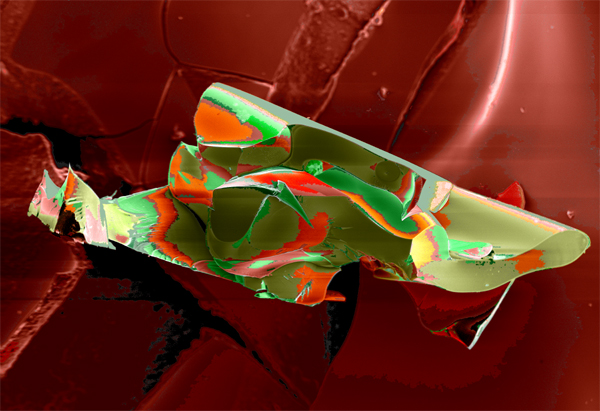
The Pause that Refreshes


J. D. Jarvis, The Pause that Refreshes, NanoArt 2006


From NanoArt 2006. © Copyright J. D. Jarvis (click to see larger version)

NANOART is a new art discipline related to micro/nanosculptures created by artists/scientists through chemical/physical processes and/or natural micro/nanostructures that are visualized with powerful research tools like Scanning Electron Microscope and Atomic Force Microscope.

NanoArt could be for the 21st Century what Photography was for the 20th Century. We live in a technological society, in a new Renaissance period, and there is no reason for Arts to stay away from Technology. NanoArt is the expression of the New Technological Revolution and reflects the transition from Science to Art using Technology.


See all of J. D. Jarvis' NanoArt 2006 entries here, or visit his website.

Quote of the day

"We live in a technologically intensive society where the rate of technological advancement is accelerating at a pace many find troubling. In the past thirty years we have experienced more dramatic changes brought about by technology than ever before in history. Given some in-depth insights into advanced technology, research organizations (both public and private) predict there are wondrous new developments ahead that will shape our lives. These scientific and technological breakthroughs have far-reaching political, economic and social implications. These implications are not limited in scope to the country or jurisdiction where the development takes place but throughout the world."

~Kevin G. Coleman, Ph.D., Senior Fellow with the Technolytics Institute


Commenting on how society can cope with the massive changes that will result from our understanding of the nanoscale, Dr. Robert D. Atkinson (1) said: "We should not use the precautionary principle as our guide, nor should we just ignore the potential problems. We should go forward with research on nano while at the same time go forward with research into the potential problems from nano and the solutions to them."

(1) Vice President and Director of the Technology and New Economy Project, Progressive Policy Institute (link). Author, "The Past and Future of America's Economy: Long Waves of Innovation that Power Cycles of Growth"


"Lurking just beyond the horizon, there is a globe-spanning, international business-changing, society-altering tsunami - from which we're catching the first waves, now. Companies, governments, and institutions are already being forced to consider a blinding rate of technological change; many finding themselves woefully unprepared. The rate at which the waves hit will likely increase, as technology advances on a double-exponential curve. Those that don't take the first preparatory steps now for massive changes soon better find someone who can, before they find themselves taking those first steps down the path towards the "dustbin of history."

~Rocky Rawstern, Editor, Nanotechnology Now (nanotech-now.com). Sept. 2003

A Transparent Society, Maybe

“The new Smart Nanobattery architecture promises an energy source that can be packaged in various configurations, with shelf life lasting decades, yet still able to be activated almost instantaneously on demand. Various battery designs based on this technology may deliver a new and unique component for system design across many fields, including defense, industrial and consumer electronics.” link

“…'next generation' computer chips which will see processors with mind-boggling memories the size of a grain of sand.”

“The new technology will have military uses with tiny spy planes the size of flies able to collect and send back information over hundreds of miles.” link


OK, those were some semi-random headlines gleaned from recent nanotech news. Semi-random since I was looking for technologies that will enable ubiquitous surveillance, but picked from amongst dozens of others that fit the “nano” mold. And keep in mind that there have been literally hundreds of similar improvements in various supporting technologies in the past few years. It seems probable that improvements along these lines will continue, and the rate at which these advances become part of “today’s technologies” will continue to increase.

So, we’ve got technologies that reduce the size of sensors, technologies that reduce the size of sensor batteries, and technologies that reduce the size and increase the capacity of memory modules. What does it all mean? It means that sometime in the not-to-distant future, perhaps 5 to 10 years from now, we will have the ability to construct cheap (nearly free) sensors that will be difficult if not impossible for the human eye to detect. These sensors will have the ability to detect everything from conversations to chemicals, and send their findings hundreds, if not thousands of miles (using satellite uplinks) to whoever is monitoring them.

What do we do about it? I don’t know. What I do know is that this “possible future” will be an issue, and probably one of the most socially disruptive of all the near term “nanotechnologies.” (A better term is “nanotechnology-enabled technology”)

In closing, I’d like to refer back to a note I made earlier about David Brin’s compelling argument in The Transparent Society: Will Technology Force Us to Choose Between Privacy and Freedom? Brin argues for a more open society; “one in which those in power would be required to adhere to the same "openness" standards as their constituents, where the authorities are monitored as well as monitoring.” Maybe this is the answer; I don’t know, but it is a place to start the debate; a debate that needs to begin soon, and needs to include all stakeholders.

Wednesday, February 7, 2007

Picture of the day


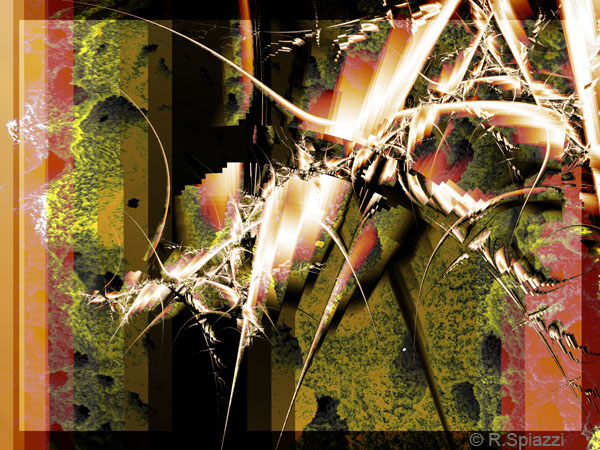
Orderly Chaos


Renata Spiazzi, Orderly Chaos, NanoArt 2006


From NanoArt 2006. © Copyright Renata Spiazzi (click to see larger version)

NANOART is a new art discipline related to micro/nanosculptures created by artists/scientists through chemical/physical processes and/or natural micro/nanostructures that are visualized with powerful research tools like Scanning Electron Microscope and Atomic Force Microscope.

NanoArt could be for the 21st Century what Photography was for the 20th Century. We live in a technological society, in a new Renaissance period, and there is no reason for Arts to stay away from Technology. NanoArt is the expression of the New Technological Revolution and reflects the transition from Science to Art using Technology.


See all of Renata Spiazzi's NanoArt 2006 entries here, or visit her website.

Quote of the day

"As an emerging science in its infancy, nanotechnology promises the nano-scale manufacture of materials and machines made to atomic specifications. The impact of nanotechnology on our way of life is widely believed to reach profound and hitherto unimagined levels in the coming decades. Proposed changes include clean abundant energy, pollution-free and inexpensive production of superior defect-free materials, complete environmental restoration and cleanup, safe and affordable space travel and colonization, and quantum leaps in medicine leading to perfect health and immortality. As a result of these advances, we anticipate the obsolescence of nearly all of today's industrial and economic processes by the first half of the new century, leading to global and radical changes in life style, finance, law, and politics."

~Behfar Bastani, Dennis Fernandez link

NanoArt

Today I’d like to point readers to the website of my friend, Cristian Orfescu, and to his NanoArt site.

Cris’ personal website is absolutearts.com. Of particular interest to regular readers and visitors is the section on NanoArt. There you will find examples of art created from science, using technology.

As Cris puts it: “My art is a reflection of the technological movement. I consider NanoArt to be a more appealing and effective way to communicate with the general public and to inform people about the new technologies of the 21st Century. NanoArt is intended to make the public aware of Nanotechnology and how will this impact our lives.”

By day, Cris is a materials scientist and manager of the analytical laboratory at Caleb Technology. This means that he understands nanoscale materials. What he’s trying to do with NanoArt is to help the public understand nanotechnology. He says that he thinks people are unaware of the benefits that nanotechnologies could bring, instead focusing on the perceived dangers. I believe he’s on the right track; many people will probably find that through art, they will be better able to get a handle on advanced science.

As a science writer, I am fascinated by the way Cris uses a scanning electron microscope to create the underlying images, which he then manipulates with PhotoShop to create stunning, three dimensional final products.

As an aspiring artist myself, I find myself drawn into and captivated by his artwork.

His other project is the NanoArt competition. You can view, and are encouraged to vote for, 71 images from 22 artists. While there are many outstanding examples of “science turned art,” my favorite is the one you see as the Picture of the day.

My favorite work by Cris is:

Tribute to Kubrick's Space Odyssey 2001

Cristian Orfescu, NanoArt 2006, Tribute to Kubrick's Space Odyssey 2001


A nanosculpture created by freezing a tiny drop of colloidal graphite (graphite nanoparticles in a suspension) in Liquid Nitrogen at -196 deg C. The monochromatic scan has been painted digitally. (click to see larger version)

If you then visit his site or buy one of his images, please tell him I sent you.