Tuesday, February 13, 2007

Picture of the day


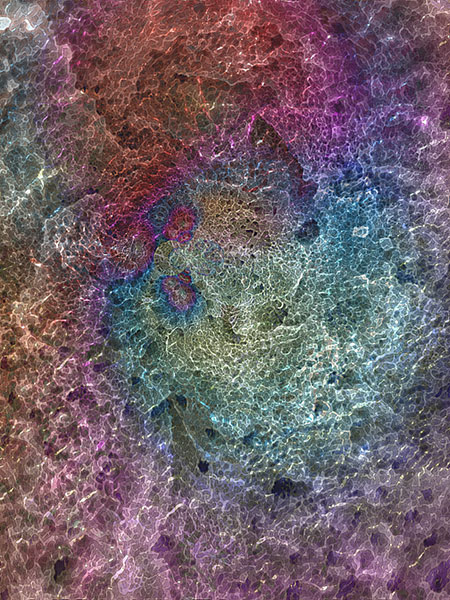
Untitled 5


Diane Vetere, untitled 5, NanoArt 2006


From NanoArt 2006. © Copyright Diane Vetere (click to see larger version)

NANOART is a new art discipline related to micro/nanosculptures created by artists/scientists through chemical/physical processes and/or natural micro/nanostructures that are visualized with powerful research tools like Scanning Electron Microscope and Atomic Force Microscope.

NanoArt could be for the 21st Century what Photography was for the 20th Century. We live in a technological society, in a new Renaissance period, and there is no reason for Arts to stay away from Technology. NanoArt is the expression of the New Technological Revolution and reflects the transition from Science to Art using Technology.


See all of Diane Vetere's NanoArt 2006 entries here, or visit her website.

Please contact me if you would like to submit an image. (rocky at bir-consulting.com)

Quote of the day

While eager to invest in nanotechnology, in the past two years some VC firms have been cautious to invest in specific nanotech companies for a variety of reasons. The primary reason being the lack of understanding of the technology and the nanotech market.

The US Nanotechnology Environment - Where is the business?


"We must always be vigilant when protecting America. Oregon firms are developing technology that will help make our nation safer and protect troops abroad. Many of the projects have applications beyond the battlefield. The investments we are making today will have lasting benefits into the future. This investment also sustains jobs ensuring Oregon's economy continues to grow."

~Senator Gordon Smith (R-OR)


Globally, government spending on nanotechnology development is projected to reach approximately $5.0 billion (U.S.) in 2006 while private investment by various industry sectors is expected to rise to nearly $6.0 billion in the same period.

link

Investing In Nanotech

Still working on my business site, so today I would like to point you to an interview I did with Douglas Jamison, Vice President of Harris & Harris Group.

RR: What is your definition of nanotechnology?

Harris & Harris Group, Inc. invests in tiny technologies, which we define as nanotechnology, Microsystems and microelectromechanical systems (MEMS). Our primary focus is nanotechnology. One must remember that we invest in what we hope are good business opportunities, not definitions. It just so happens that we focus on business opportunities that leverage proprietary technologies that happen to be at the nanoscale. With that in mind, we tend to define nanotechnology as the creation of useful materials, devices and systems through the engineering of properties at the nanoscale and the unique properties and phenomena observed in this size regime.

RR: What are the typical sources for deals? Outside referrals? Referrals by associates? Conferences & events networking? Blind submissions by Internet or mail? Other?

We have looked at over 225 business opportunities in 2004. These opportunities come from research institutions, other venture capital groups, the companies themselves, our directors and associates and through unsolicited channels. I believe that because we are active in the space, nanotechnology companies know that their plans will have an audience from Harris & Harris Group. Access to quality deal flow is essential for venture investors, and it is important to remember that we have seen over 225 business opportunities but only invested in five in 2004.

RR: Overall, what do you like about nano as an investment area?

I like the opportunity to invest in the research coming out of a few of the premier research labs in the country in an emerging area of science that often provides for broad intellectual property coverage before too much capital chasing too few deals has led to capital market myopia. Just as in the early days of biotechnology, the quality of people is astounding, and I spend most of my days being the dumbest person in the room, which means I am always learning something.

Read the entire interview, here:
http://www.nanotech-now.com/products/nanonewsnow/issues/017/017.htm#main

Monday, February 12, 2007

Picture of the day


NanoFoam


Ursula Freer, NanoFoam, NanoArt 2006


From NanoArt 2006. © Copyright Ursula Freer (click to see larger version)

NANOART is a new art discipline related to micro/nanosculptures created by artists/scientists through chemical/physical processes and/or natural micro/nanostructures that are visualized with powerful research tools like Scanning Electron Microscope and Atomic Force Microscope.

NanoArt could be for the 21st Century what Photography was for the 20th Century. We live in a technological society, in a new Renaissance period, and there is no reason for Arts to stay away from Technology. NanoArt is the expression of the New Technological Revolution and reflects the transition from Science to Art using Technology.


See all of Ursula Freer's NanoArt 2006 entries here, or visit her website.

Please contact me if you would like to submit an image. (rocky at bir-consulting.com)

Quote of the day

"Nanotechnology has tremendous potential to improve the quality of life for our citizens, create high paying jobs, and increase U.S. global competitiveness. Unfortunately, the government has not made the economic development aspect of nanotechnology much of a priority. We're going to try to do that."

~Gordon Smith (R-OR)


If there is one overarching grand challenge that nanoscience presents to us, it is the possibility to do an immense amount of good for humanity. From an economic perspective, the emerging NanoEconomy promises to create more jobs, fuel more innovative products, perhaps heal and cure more patients extending life and health.

~James Canton, Ph.D. CEO, Institute for Global Futures


"Investing in innovation is the key to a vibrant US manufacturing base and the continued generation of new jobs. Nanotechnology has the potential to create entirely new industries and radically transform the basis of competition in other fields."

~Mike Honda (D-CA)

Behind the Buzzword

I’m working on a major upgrade to my business site (bir-consulting.com) so today I would like to point readers to an excellent article by my friend and colleague Pamela Bailey, President tinytechjobs.

What working in nanotechnology really means

There's no doubt that a career in nanotechnology would be both interesting and challenging. But what, exactly, is nanotechnology--and what would a career in nanotechnology actually be like?

Essentially the ability to control the atomic and molecular building blocks of material, nanotechnology will be applied to change or create chemical, electronic, magnetic, optical, and structural properties in materials or nanostructures. These materials will then be assembled and/or utilized for new processes and devices. Nanotechnology is an enabling technology that will be used in many applications across many industries, including computing, communication, transportation, energy, materials, manufacturing, cosmetics, healthcare, biotechnology, pharmaceuticals, the environment.

You can therefore work in nanotechnology in a range of settings. If you are not doing basic discovery work in one of the many university-based or government-funded research programs, you could be working in a biotechnology company on a nanoparticle-based molecular system for detecting biological warfare agents or fabricating a miniature terahertz laser for medical diagnostics. The adoption of nanotechnology-based applications by large pharmaceutical and biotechnology companies, as well as diagnostic companies, means that you could have the opportunity to work on a new therapeutic drug or a novel drug delivery process.


To read the entire article, visit http://www.nanotech-now.com/products/nanonewsnow/issues/014/014.htm#Pamela-Bailey