Tuesday, March 27, 2007

Picture of the day


Nano flower bouquet

Nano flower bouquet, Ghim Wei Ho and Prof Mark Welland

At the time this image was created, Ph.D. student Ghim Wei Ho was doing research in the lab of Prof. Mark Welland. Her project involved the fabrication and characterization of novel nanostructures. "For the remainder of my Ph.D., I will be focussing on the potential device aspects of these extraordinary structures," she said. (click to see larger version)

To see the entire series, visit the Nanotechnology Now Gallery.

Courtesy of and Copyright © Ghim Wei Ho and Prof Mark Welland, University of Cambridge Nanoscale Science Laboratory

Quote of the day

"The current public calm surrounding nanotechnology -- and the public's lack of awareness about nanotech -- could change radically. All it would take would be mass media coverage of a research finding of a potentially dangerous health effect to consumers who are currently unknowingly exposed to nanoparticles in their sunscreens or cosmetics."

~Sharon M. Friedman, Professor, Lehigh University


"The need to engage the public in a dialogue about nano's potential benefits and risks, and how government proposes to manage them, has never been greater or more propitious. Without such an effort, nanotechnology's benefits could be lost in a sea of scary headlines and confused publics."

~Julia A. Moore, Deputy Director, Project on Emerging Nanotechnologies


"The results of the citizens' jury suggest that nanotechnology is not perceived as a serious threat to the values of anyone but die-hard anti-technologists."

~Nature Magazine. From: Nanojury UK - the final verdict at http://www.softmachines.org/wordpress/?p=159


"Any new technology is associated with risks. Stone age man discovered the hand axe to cut materials, but the tool was also a powerful weapon. But nanotechnology doesn't pose any greater threat than other established technologies. In any case, there's no sense in elaborating frightening scenarios that are just as misleading as naive promises that 'the whole thing's harmless.' It would be more effective for the development of this new technology to be accompanied by information, education and critical examination."

~Bayer


To suggest that nanotech is the next asbestos scandal is "an overreaction. There's a lot of (research) work that needs to be done, but there is nothing indicating there's going to be a serious problem, not at the moment."

~Andrew Maynard, chief science adviser at the Project on Emerging Nanotechnologies at the Woodrow Wilson International Center for Scholars in Washington, D.C. From: Big troubles may lurk in super-tiny tech at http://sfgate.com/cgi-bin/article.cgi?f=/c/a/2005/10/31/MNG28FGMVJ1.DTL

Nanotech threat exaggerated

As I’ve said in the past, and will undoubtedly say again, I won’t normally cover breaking news in this blog. Today I make an exception for news on “the nanotech threat.”

Word comes to us from Ron Turco at Purdue University that “neither dry nor water-based forms of buckminsterfullerenes—carbon nanoparticles containing only tens to hundreds of atoms called buckyballs—have ill effects on soil or the microorganisms it contains.”

This is good news for all the companies that are contemplating using fullerenes in their products. It is bad news for enviro groups that have long been playing up the hype on certain misread “buckyball and fish” studies (1).

While this study is encouraging, Turco “adds the caveat that he tested only a few types of nanoparticles and that further tests must be done on a broader array of particles before conclusions can be drawn.” I believe he is referring to other types of nanoparticles, such as nanotubes, which hold huge promise and are already being touted as the next big thing in materials, where strength and weight properties are paramount (think aerospace, military and space applications).

It is a fact that other nanoparticles need to be tested for toxicity, while at the same time recognizing the need for latitude in their use when embedded in polymers and such (where they are unlikely to become separated, any more than their larger cousins in the materials world).

Businesses that contemplate using nanoparticles in products that will come into direct contact with living tissues absolutely need to test them for potential toxic effects, just like they do for any other material for which the effects are not known.

I also recognize that until proven safe, factory workers need to be safeguarded when handling nanoscale materials, just like they do when handling other potentially harmful materials of any scale.

Regarding regulation, a quote from Chris Anderson (editor in chief of Wired magazine) comes to mind: "When the United States bans stem-cell research, it doesn't mean the end of stem-cell research; it just means that the work gets done elsewhere, including China or India, where the scientists and technology are nearly as good but the regulations are looser. Too much regulation and the science goes feral; too little and it may run wild at home." How do you achieve a balance? I like what Sonia Arrison (Director of Technology Studies, Pacific Research Institute) says: “…modest regulation, civilian research, and an emphasis on self-regulation and responsible professional culture.”

In an article titled Can Nanotech Be Regulated? (2) and in response to the question “Will fair regulation of a field as complex as nanotechnology be possible without a radical new approach?” Richard Denison of Environmental Defense responded with: “We've dealt with some pretty tough issues in regulation and legislation, and I don't know if nano is so novel or so unique that it's going to require a whole new approach. We understand the basics of assessing hazard. We understand the basics of assessing exposure and mitigating exposure. Those need to be tailored and adapted to the characteristics of nanomaterials, but I don't know that we're talking about anything much more radical than that.” I’ll buy that.


Read the whole article Scientist claims nanotech threat is exaggerated
http://www.eetimes.com/news/latest/showArticle.jhtml?articleID=198700342


(1) Howard Lovy in an article titled Nano is a concept by which we measure our pain
http://nanobot.blogspot.com/2004/03/nano-is-concept-by-which-we-measure.html

(2) http://www.technologyreview.com/NanoTech/wtr_16176,319,p2.html

Monday, March 26, 2007

Picture of the day


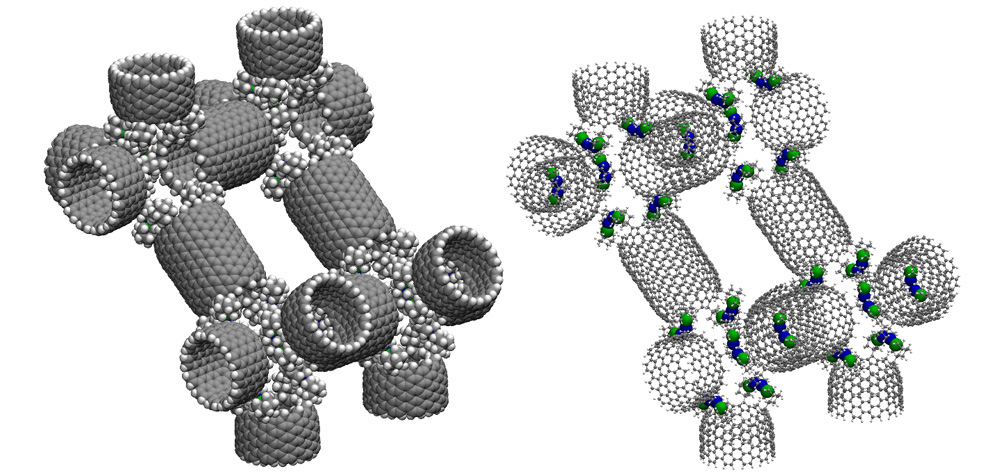
Carbon nanotube dative junction assembly


Damian Gregory Allis, Carbon nanotube dative junction assembly


Damian Gregory Allis, Ph.D.: Dative (dipolar) bonds are a potentially valuable form of noncovalent interaction for use in diamondoid and macromolecular nanostructures. These interactions require a lone pair donor, such as the lone pair of nitrogen, and an acceptor, such as the empty sp2 orbital or boron. Boron and nitrogen are both good structural replacements for the C-H fragments found in hydrocarbons (nitrogen because it is isoelectronic with the C-H unit, boron because it can accommodate three covalent bonds to leave the last orbital empty). In this design, carbon nanotubes are functionalized with adamantane-based dative hinges that lock each fragment into place to form the extended network. (Click to see larger version, where: grey = carbon, white = hydrogen, blue = nitrogen, green = boron; left: van der Waals rendering. right: ball-and-stick rendering)

These designs are the result of a collaboration with Dr. Ralph Merkle (www.merkle.com/) into the application of the dative bond in molecular building block approaches for molecular-based materials design.

All images (in this series) are the result of molecular mechanics structure calculations using either Tinker (MM2 parameters) or NAMD (CHARMM). Images were made with VMD. Any inquiries concerning methods, software, or shop talk are directed to http://www.somewhereville.com/.

To see the entire series, visit the Nanotechnology Now Gallery.

Quote of the day

Dr Andy Miah, a British bioethicist, believes there is now a new frontier in sporting technology, driven by the convergence of nanotechnology, biotechnology, information technology and cognitive science.

"We can imagine nanotechnological devices being utilised by athletes to keep them fit...these are molecular-sized devices that could be inserted into the brain to elicit certain kinds of physiological modifications." The technique has already been used to implant molecular-sized devices into the brains of people suffering from Parkinson's disease.

~From: Technology pushes sporting boundaries at http://tvnz.co.nz/view/page/411749/1035788

Interview with Jack Uldrich

Today I would like to present an interview I did with my friend and colleague Jack Uldrich on investing in nanotechnology.

RR: What have you learned since writing The Next Big Thing that helped with Investing in Nanotechnology?

I wrote Investing in Nanotechnology because I am now more convinced than ever that not only do executives need to understand how nanotechnology will affect the future of their business but now so must investors.

The advances that have been made in the field of nanotechnology since I wrote The Next Big Thing in 2003 have been absolutely startling. The pace of change is almost exponential and there is scarcely a day that goes by without some major development being announced. Those people who are unaware of these advances -- and who aren't making it a point to track these developments -- will be at a distinct disadvantage and could end up losing a sizeable amount of money. This will happen either because they miss opportunities to invest in new companies or they don't understand how some of their current investments may be rendered obsolete by new advances in nanotechnology.

RR: What do you say to potential investors about companies that are raking in tens of millions of dollars in VC funding without having a near-term product?

First off, neither VC's nor individual investors should invest in "science projects." If a company doesn't have a real product (or at least a plan to develop a real product) - stay away! Having said that, I am comfortable if a VC chooses to invest in a company that may not have a viable product for 3 to 7 years - after all it is their (or their investors) money they are using. The greater threat I think is that many of nanotechnology companies don't know which market they are going to attack first. I am always nervous when a company states that it has "exciting" or "promising" nanotech applications in a variety of markets, including the material sciences, semiconductors, energy, pharmaceuticals, etc. A good company understands which market offers its investors the best opportunity and then pursues that market. If it is successful in that area then it can move on to other areas.

RR: In your opinion, does adding "nano" to a company's name add to or take away from it's value, and why?

All things being equal, I believe the term "nano" takes away from a company's value. As I said earlier, every investor should strip the term "nano" away from the company and investigate it from the perspective of whether or not it is creating an actual product that can succeed in the marketplace. I also believe that it is possible the term "nanotechnology" could come to have a negative connotation in the public's mind at some point in the future. This is especially the case if certain nanomaterials or nanoparticles are found to have adverse affects on either the environment or human health.


To read the entire interview:
http://www.nanotech-now.com/products/nanonewsnow/issues/030/030.htm#main