Showing posts with label tools. Show all posts

Wednesday, January 21, 2009

Better Tools


In our quest to better understand the properties of nanoscale materials (which differ from their larger macroscale cousins) scientists are developing new tools such as the one used to create the image above.

"This image of an early moment in the simulated mixing of two fluids was created by researchers using a powerful new algorithm they developed to extract features and patterns from massive data sets. In the image, blue and red spheres and the lines between them represent the branching of pockets of fluid."

"A powerful computing tool that allows scientists to extract features and patterns from enormously large and complex sets of raw data has been developed by scientists at University of California, Davis, and Lawrence Livermore National Laboratory. The tool - a set of problem-solving calculations known as an algorithm - is compact enough to run on computers with as little as two gigabytes of memory."

Credit: Attila Gyulassi/UC Davis copyright UC Regent

Click on the title to read the whole article at Nanotechnology Now

Friday, April 20, 2007

The Weekly Roundup

Jeff Wacker, a futurist with Plano-based Electronic Data Systems Corp., said the evolution of nanotech into the consumer arena will be marked by three phases. "I think there's the mild, I think there's the wild, and I think there's the magical," he said. At the "mild" end of the scale in the next few years are lighter, stronger, frictionless and more efficient upgrades to existing materials, such as in airplane wings, solar panels and batteries.

At the "magical" conclusion, 10 years or more down the road, consumers can expect to see nano assemblers, minuscule factories using billions of molecule-size machines to build nearly any product imaginable out of a pile of raw materials.

RR: Another deep thinker who believes, as many others do, that advances in the nanosciences will lead to molecular manufacturing.

To learn more, visit: http://crnano.org/

From: Small molecules, big impact
http://www.nanotech-now.com/news.cgi?story_id=21916


Nanostellar, Inc., a leader in nano-engineered catalyst materials, today announced a first in diesel emissions technology: the introduction of gold as an oxidation catalyst. Nanostellar's NS Gold™ catalyst enables manufacturers of light- and heavy-duty diesel engines to reduce noxious emissions by as much as 40 percent more than existing pure-platinum catalysts at equal cost. Nanostellar introduced its first-generation product, based on a platinum and palladium alloy, in mid-2006, and it achieved 25%-30% higher performance than commercial pure-platinum catalysts. NS Gold™, Nanostellar's second-generation product, delivers a further 15%-20% performance increase.

RR: This is great news for the environment. As oil and gas prices rise and concern for the environment turns to action, expect to see technologies like this begin to make a difference.

From: Nanostellar Introduces Gold in Oxidation Catalyst That Can Reduce Diesel Hydrocarbon Emissions by as Much as 40 Percent More Than Commercial Catalysts
http://www.nanotech-now.com/news.cgi?story_id=21935


FriCSo, Inc., a developer and manufacturer of environmentally friendly technology and polymer-based devices that create a friction reduction nanolayer on moving parts, today announced that a test conducted by the Technion - Israel Institute of Technology found that FriCSo's Surface Engineering Treatment (SET) highly reduces particulate matter emissions, increases engine mechanical efficiency, and reduces fuel consumption.

RR: ditto my previous comment.

From: New Nanolayer-based Technology Highly Reduces Engine Emission and Improves Fuel Consumption
http://www.nanotech-now.com/news.cgi?story_id=21933


The use of nanotechnology is an innovation in the development of surface coatings, particularly in relation to UV absorbing and penetration. In meeting this challenge, Nanovations has introduced a new VOC-free technology for clear impregnating wood protection.

RR: Nanovations has recently released several new nanotech-enabled products. See http://www.nanovations.com.au/ then click on Products.

From: Nanovations introduces surface protection for woods
http://www.nanotech-now.com/news.cgi?story_id=21999


There seems to be an arms race going on among nanotechnology investment and consulting firms as to who can come up with the highest figure for the size of the "nanotechnology market". The current record stands at $2.95 trillion by 2015.

RR: An excellent article! Michael Berger debunks the hyper-hyped “trillion dollar” figures being casually thrown around. “…trillion-dollar forecasts for an artificially constructed ‘market’ are an irritating, sensationalist and unfortunate way of saying that sooner or later nanotechnologies will have a deeply transformative impact on more or less all aspects of our lives.”

From: Debunking the trillion dollar nanotechnology market size hype
http://www.nanowerk.com/spotlight/spotid=1792.php


Billionaire investor Wilbur Ross, who has made most of his money restructuring failed companies in such unglamorous industries as steel, coal, and most recently, textiles, is not the kind of guy to jump on the latest technology fad. Therefore, when someone like Ross begins investing in nanotechnology, I believe it serves as further validation that the technology is moving into the mainstream.

RR: Jack Uldrich (Access Team member -- access-nanotechnology.com/our-team.htm) sums it up nicely “My point here is that Ross is not a venture capitalist. He is a practical, experienced businessman with a great nose for turning around companies. If he's investing in nanotech, it's not because he thinks it's a fad, but because he thinks there's great value in these companies.”

From: Nanotech Wins a Convert
http://www.fool.com/investing/high-growth/2007/04/18/nanotech-wins-a-convert.aspx


"Nanotechnology could not only change our whole economy and the quality of life of Russian people, but can also drastically change all our perception about modern warfare." Sergei Ivanov, Russian first deputy prime minister
http://en.rian.ru/russia/20070419/63937318.html

Russian President Vladimir Putin has urged the government to ensure the effective spending of the major funds that will be invested in the development of nano-technologies. “This is a line of business the state will spare no effort or funds to develop,” Putin said at a conference devoted to the development of this branch of science. “The question is how to ensure this be arranged for properly and the funds be spend (sic) effectively. He said nanotechnology will lay the groundwork for new weapon systems, both offensive and defensive.

Russia is currently concentrating material and human resources to produce arm systems based on nanotechnologies, President Vladimir Putin said.
http://www.nanotech-now.com/news.cgi?story_id=22063

Russia will pour over US$1 billion (€740 million) in the next three years into equipment for nanotechnology research as it uses massive oil and gas export earnings… Ivanov predicted that 90 percent of nanotechnology developments would be used for civilian purposes and 10 percent for military purposes. http://www.iht.com/articles/ap/2007/04/18/technology/EU-TEC-Russia-Nanotechnology.php

RR: This one is pieced together from three articles. Given the thousands of scientists at large in Russia, combined with the billion dollar investment, expect to see significant progress in the nanosciences.


Since the 1960s, the best way to isolate precise instruments like atomic-force and scanning-tunneling microscopes along with fab tools from vibration was passive air tables that support weight on a cushion of air. A recent alternative is using active electronic feedback to send cancelling forces that damp out oscillations in springs.

RR: Good news on the “tools” front.

From: 'Negative stiffness' used to damp vibrations
http://www.nanotech-now.com/news.cgi?story_id=22059


A domestic water filter that uses metal nanoparticles to remove dissolved pesticide residues is about to enter the Indian market. Its developers at the Indian Institute of Technology (IIT) in Chennai (formerly Madras) believe it is the first product of its kind in the world to be commercialized. 'Based on consumption patterns of a typical Indian household, the filter is designed to have enough nanomaterials to provide 6000 litres of pesticide-free water for one year,' Pradeep said. 'After that, the company will recycle the filters to recover the silver.'

RR: At an estimated cost of £115 ($230) it may find difficulties entering the US market in any quantity. I can buy water that has been micron filtered, UV irradiated, charcoal and reverse osmosis filtered for 25 cents per gallon at the local food mart. At $230 for the filter, it would cost about $7 per gallon, which may be an acceptable figure for areas with pesticide residue problems.

From: Pesticide filter debuts in India
http://www.nanotech-now.com/news.cgi?story_id=22073


Nanoexa announced today that its subsidiary Decktron will combine technologies to develop lithium batteries that will outperform currently available batteries. The batteries could end up in plug-in electric hybrid vehicles.

RR: Yet another entry in the rapidly expanding list of companies that are vying for king of the nanotech-enabled battery market. Given the incentives (think global warming, massive pollution, and peak oil) I don’t doubt that before the dust settles there will be many more companies trying to cash in on this seemingly lucrative market.

From: High-Performance Batteries Could Solve Energy Storage Problem for HEVs
http://www.nanotech-now.com/news.cgi?story_id=22046


G24 Innovations Limited (G24i), a Cardiff -based company that aims to revolutionise solar power by leading the development of extremely lightweight, flexible solar cells, is to sponsor a competition with students from Central Saint Martins College of Art and Design to design a product that uses the company's cutting edge technology.

RR: Good news, and another indicator that alternative energy technologies are being taken seriously.

From: Cardiff sponsors solar energy contest
http://www.nanotech-now.com/news.cgi?story_id=22045


Curcumin, an element found in the cooking spice turmeric has long been known to have positive effects against certain types of cancer. Effective treatments based on curcumin however have been limited due to its poor dissolving capabilities in water based substances, leading to low absorption rates when ingested. Researchers affiliated with the Institute for NanoBioTechnology at Johns Hopkins University report to have overcome this problem by encapsulating free curcumin with a polymeric nanoparticle, creating nanocurcumin.

RR: I find it encouraging that scientists continue looking to nature in an effort to deal with one of mankind’s most deadly killers. Add “nanocurcumin” to your list of nano-things to watch.

From: Polymer Coated Curcumin Promises Effective Against Cancer
http://www.nanotech-now.com/news.cgi?story_id=22076


The ability to eliminate waste and toxins from production processes early on, to create more efficient and flexible solar panels, and to remove contaminants from water, is becoming an exciting reality with nanotechnology. This "green nanotechnology" involves designing nanoproducts for the environment and with the environment in mind.

RR: Live webcast, Thursday, April 26, 2007, 10:00 - 11:00 a.m.

From: Green Nanotechnology: It’s Easier Than You Think
http://www.nanotech-now.com/news.cgi?story_id=22051


The global search for a sustainable energy supply is making significant strides at Wake Forest University as researchers at the university's Center for Nanotechnology and Molecular Materials have announced that they have pushed the efficiency of plastic solar cells to more than 6 percent.

RR: Given the rising cost of silicon, couple with the need for alternative energy sources, efficient plastic solar cells (should they become more efficient and/or cheap) may make, as they say “plastic devices the photovoltaic of choice.”

From: Plastic solar cell efficiency breaks record at WFU nanotechnology center
http://www.nanotech-now.com/news.cgi?story_id=22027


Industrial Nanotech, Inc. (Pink Sheets:INTK), an emerging global leader in nanotechnology, announced today that it has entered into negotiations with a Fortune 100 company for the incorporation of the Company's patented nanotechnology based coating, Nansulate®, into their products. The Company estimates the value of the project to be approximately 4.5 million dollars annually once an agreement is reached.

RR: These guys are everywhere with their insulation product. Keep an eye on them as they break into new industries.

From: Industrial Nanotech, Inc. Enters Negotiations with Major Electronics Manufacturer
http://www.nanotech-now.com/news.cgi?story_id=22009


For custom reports on nanotech and cleantech news and developments, please contact me at rocky at access-nanotechnology.com

Contact me at the same address to discuss a complimentary evaluation of your project needs. Or visit http://access-nanotechnology.com/


Friday, April 13, 2007

The Weekly Roundup

Here are some of the news bits that caught my eye this week:

Students from the competition's NanoFresh group had their own innovative ideas. The team presented a water purifying mechanism designed for backpackers, travelers and commercial facilities such as schools and offices. According to team member Lyle Kaplan-Reinig, a fourth-year chemical engineering major, the group's goal for the product was for it be an easy-to-use household mechanism that eliminates harmful carcinogenic compounds found in tap water.

The first-place winner of the final competition will receive $10,000 to start up their business. Another $23,000 will be given out for the various other prizes.

RR: This is a great way to generate the next batch of technologies and products. Enable our country’s best and brightest young minds with a little cash incentive. While the dollar amounts are low, they do serve as an incentive, and are, at the very least, a step in the right direction. Anything we (the previous batches of "young minds") can do that serves to set free these young minds will be to our benefit.

From: Contest Finalists Display Inventions
http://www.dailynexus.com/article.php?a=13762


It’s a big feat of the tiniest proportions. Simon Fraser University’s Nano Imaging Lab has produced the world’s smallest published book. At 0.07 mm X 0.10 mm, Teeny Ted from Turnip Town is a tinier read than the two smallest books currently cited by the Guinness Book of World Records.

RR: This latest nanotrek (an adventure into the nanoscale) serves to illustrate our ever-expanding ability to control the nanoscale.

From: Nano lab produces world’s smallest book
http://www.sfu.ca/mediapr/news_releases/archives/news04110701.htm
image here: http://www.nanowerk.com/news/newsid=1773.php


Deformable, spherical aggregates of metal nanoparticles connected by long-chain dithiol ligands self-assemble into nanostructured materials of macroscopic dimensions. These materials are plastic and moldable against arbitrarily shaped masters and can be thermally hardened into polycrystalline metal structures of controllable porosity. In addition, in both plastic and hardened states, the assemblies are electrically conductive and exhibit Ohmic characteristics down to 20 volts per meter. The self-assembly method leading to such materials is applicable both to pure metals and to bimetallic structures of various elemental compositions.

RR: Yes, I know, that paragraph is a mouthful. What it means to me is that once again we’ve discovered a new way to create materials that may enable a whole new range of products. Harkening back to The Graduate, the phrase "I just want to say one word to you -just one word. ‘Plastics’" comes to mind, only this time with a nanotech twist. Our understanding of the nanoscale, and the often-unique phenomena found there, is looking more and more likely to enable a new generation of plastics. This news bit is just one of many recent articles that supports that assumption.

From:
Plastic and Moldable Metals by Self-Assembly of Sticky Nanoparticle Aggregates
http://www.nanotech-now.com/news.cgi?story_id=21888


The stretching alignment technique is applicable to a broad range of SWNT experiments where orientation is important, particularly in optics. The work should further our current understanding of how nanotubes interact with light, with important practical applications in optical sensing and the manipulation of individual nanotubes using electromagnetic fields.

RR: Getting nanotubes to do what we want remains one of the main logjams in commercializing products that incorporate them.

From: Stretching exercises shed new light on nanotubes
http://www.nanotech-now.com/news.cgi?story_id=21886


NCR Corp. is spinning off a new company that is developing a technology capable of combating the counterfeiting of cash, pharmaceuticals and military parts, the new company's CEO said Thursday.

Prime is developing a nano-technology that has its origins in NCR labs, Ricci said. Essentially, the process — known as LumID or luminescent identifier — creates very tiny glass beads with "chemical tags" allowing whatever has been embedded with the beads to be accurately identified, he said.

RR: Anti-counterfeiting may prove to be one of the nanotechnologies that brings greater public acceptance to an often contentious yet unrelated group of advanced technologies. Several stridently vocal anti-technology groups have been tarring all nanotechnologies with the same brush, effectively and unfairly equating those that may have downsides to all others.

From: NCR spins off company to combat counterfeit cash
http://www.nanotech-now.com/news.cgi?story_id=21883


Civil Society-Labor Coalition issues an open letter to the international nanotechnology community at large:To All Interested Parties:We, the undersigned, submit this open letter to the international nanotechnology community at large. We are a coalition of public interest, non-profit and labor organizations that actively work on nanotechnology issues, including workplace safety, consumer health, environmental welfare, and broader societal impacts.

RR: The Civil Society-Labor Coalition weighs in on the latest proposal by DuPont Chemical Company (DuPont) and Environmental Defense (ED) for "a voluntary ‘risk assessment’ framework for nanotechnology." Yes, they do make some good points, such as "Nanotechnology’s rapid commercialization requires focused environmental, health and safety research, meaningful and open discussion of broader societal impacts." However, saying "We strongly object to any process in which broad public participation in government oversight of nanotech policy is usurped by industry and its allies" is putting the cart before the horse; why does the DuPont/ED framework necessarily mean that broad public participation will go by the wayside? Of course it doesn’t, and there are efforts, here and abroad, to engage the public (visit www.nanotech-now.com/preparing-for-nanotechnology.htm to read about some of them). Are those efforts enough? I don’t know, and neither (I suspect) does the Civil Society-Labor Coalition.

From: Activist groups reject DuPont-ED nanotechnology risk framework
http://www.nanotech-now.com/news.cgi?story_id=21875


Mihail Roco, the National Science Foundation's senior advisor for nanotechnology and key architect of the National Nanotechnology Initiative, visited Rice's Center for Biological and Environmental Nanotechnology (CBEN) this spring for a three-day conference on nanotechnology-enabled water treatment. During his visit, Roco discussed the conference, CBEN and the future of U.S. nanotechnology with Rice News' Science Editor Jade Boyd.

RR: This bit goes to illustrate a beneficial use of one nanotechnology; the treatment of water. I recommend this article be read in full. Roco doesn’t sugar-coat the need to prepare for potentially negative environmental effects, and in fact, he’s speaking at the leading R&D center that was created just for that purpose, and talks about the need to prepare.

From: The future of nanotechnology
http://www.media.rice.edu/media/NewsBot.asp?MODE=VIEW&ID=9459&SnID=193827417


The year is 2027 and you're feeling decidedly unwell. Suspecting something a little more sinister than a common cold, your GP takes a sample of your saliva with a small dipstick-shaped implement coated in sensitive high-tech nanoparticles.

The colour change of the nano-particles instantly identifies the nature of the problem. The bad news is that you have a potentially debilitating genetic disease. The good news is that your doctor can quickly prescribe a customized treatment: several billion specialized nanoparticles which will enter your bloodstream and modify the offending gene at the molecular level.

RR: This ties in nicely with my "Interview with NanoTumor Center" – see (1), and "Nanomedicine at Johns Hopkins" – see (2), and "Nanomedicine Today" – see (3). And don’t be surprised to see these and other "nanomedicines" well before 2027.

From: Nano scientists make huge advances
http://www.nanotech-now.com/news.cgi?story_id=21853

(1) http://nanoscale-materials-and-nanotechnolog.blogspot.com/2007/03/interview-with-nanotumor-center.html
(2) http://nanoscale-materials-and-nanotechnolog.blogspot.com/2007/03/nanomedicine-at-johns-hopkins.html
(3) http://nanoscale-materials-and-nanotechnolog.blogspot.com/2007/01/nanomedicine-today.html


In order to assist high school students to think about the future with nanotechnology the Clarion University nanotechnology program and the art department are sponsoring a digital art contest, "Nanotechnology and the Environment for High School Students."

"The contest asks students to digitally illustrate what they think the future of nanotechnology and the environment hold. What will the effect of nanotechnology be on the environment? Will it solve our pollution and climate change problems or create environmental disasters undreamed of before? Only student creativity can tell us."

RR: This is one way to gauge public perceptions regarding nanotech.

From: Clarion University sponsors nanotechnology digital art contest
http://www.nanotech-now.com/news.cgi?story_id=21796


Venture capitalist, scientist and newsletter advisor, Josh Wolfe - in The Forbes/Wolfe Nanotech Report - looks at two favorite buys in the sector. In this case, he is selecting stocks that make the high-tech tools needed by researchers involved in nanotech.

RR: Who is making money in nanotech in these early days? Tool makers, of course.

From: A trio of experts looks at nanotech
http://www.nanotech-now.com/news.cgi?story_id=21791


Starpharma Holdings Limited makes and develops its products using nanotechnology. Its main drug is called VivaGel, a gel-based microbicide designed to protect women from sexually transmitted diseases, including HIV. The gel has made it through Phase 1 clinical trials, and the United States Food & Drug Administration (FDA) has even granted the drug fast-track status — and fast-track designation is nothing to scoff at.

RR: Great news, both in terms of a product that holds huge potential, and for the fact that it has received fast-tract status (meaning that the approval process could take a decade or more less time).

From: Starpharma Holdings Limited’s VivaGel on the Fast Track to the Market
http://www.nanotech-now.com/news.cgi?story_id=21785


The Deal's Tech Confidential was released last week and profiled five clean technologies that venture capitalists are showing increased interest in. Here's a quick rundown on those technologies and some venture-funded startups working in each area…

RR: Another positive indicator that clean technologies are starting (finally!) to garner the investment attention they deserve. Does anyone really not understand that we need more than one solution to all the problems generated by our use of and addiction to foreign oil?

From: 5 clean technologies drawing intense VC interest
http://www.nanotech-now.com/news.cgi?story_id=21770


For custom reports on nanotech and cleantech news and developments, please contact me at rocky at access-nanotechnology.com

Contact me at the same address to discuss a complimentary evaluation of your project needs. Or visit http://access-nanotechnology.com/

Thursday, April 5, 2007

Interview with FEI's Mike Thompson

Today, I would like to present an interview I did with Mike Thompson, Business Development Manager, Nanotechnology at FEI Company.

RR: "Nanotechnology" is an oft-abused term; what definition do you use?

Your oft-abused comment is justified as the term "Nanotechnology" has a chameleon quality and shifts according to the environment in which it is placed; now as our awareness of Nanotech becomes mature we need to be more specific.

The interest and considerable investment associated with the nanotechnology rests in the fact that there is a transitions zone in the properties of matter as one shifts from atoms to bulk materials. The zone in which properties change rapidly is in the linear dimensional range of approximately 1nm to 100nm, this range is often quoted in definitions. As range is an approximation we can capture its meaning by using the term "nanoscale". The objective of nanotechnology is new, and is to functionalize this size/shape property dependence of nanoscale matter. This approach differs from past, current and future engineering which has the objective of functionalizing the "invariant properties" of bulk matter.

Many definitions of "Nanotechnology" are misleading as they can include "science" as a component of the definition. This is at best a convenience as much of what we read about today relates to science at the nanoscale. Here we should emphasize that nanoscale research is essential work as we cannot efficiently functionalize events at the nanoscale until we can understand, and characterize, their properties. The amount of research and engineering which is required to commercialize Nanotechnology is a huge undertaking and has probably been underestimated. While science is a precursor to the creation of a potential product, the contribution is one of the enablement and as should not be incorporated in the definition of "Nanotechnology."

RR: By your estimation, how large (in terms of $US) is the nanotech tools market today? How does that compare to 10 years ago, and how will it compare to 10 years from now?

In 1995, the "nanotools" market was under $US 300 Million US. The total Nanotech tools served available market in 2005 was close to $US 1 Billion. Market growth is expected to be roughly 14% per year through 2008. Predictions beyond this point are speculative and will depend upon the rate of adoption rate of tools by industry as nanoscience-based products move from prototyping through to production.

Read the entire interview, here:
http://www.nanotech-now.com/products/nanonewsnow/issues/034/034.htm#main

Tuesday, January 2, 2007

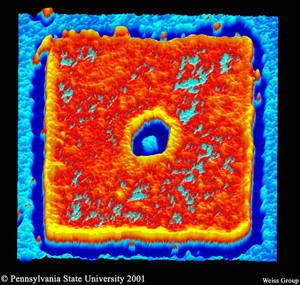
Picture of the day


Wise Group, Penn State


A field emission scanning electron microscopy image showing a ~30 nm gold dot formed in the center of a hollow gold parent structure supported on an oxidized Si substrate. This nanostructure was fabricated by a 'molecular ruler' resist process developed to extend the range of conventional nanolithography techniques.

Acknowledgements: A. Hatzor & B. A. Mantooth.

As with the previous picture, I will post the others in this series over time. To see it all now, visit the Nanotechnology Now Gallery.

"We focus on gaining atomic-scale understanding and control of materials properties. We do this by exploring, probing, and manipulating interactions and dynamics at surfaces and interfaces. We use and extend scanning tunneling microscopy to explore the surface structures, motion, and perturbations due to adsorbed atoms and molecules and due to surface features such as substrate steps and defects. We locate, study, and try to exploit the regimes in which our intuition based on macroscopic measurements breaks down. We are exploring the phenomena to be used, the ground rules, and the ultimate limits in nanometer-scale electronics and storage. Our microscopes serve not only as probes, but also allow us to manipulate matter on the atomic scale. We can thus interrogate the properties of uniquely configured atomic-scale structures. This has required the development of new tools with atomic-scale views of the surface. One new effort in our group looks at how we can bridge the gap between conventional optical microscopies and scanning probe microscopies."

—Paul S. Weiss, Professor of Chemistry, Pennsylvania State University. Weiss Group Featured Images